If your total income results in nil tax liability, yet TDS deductions continue to apply on your interest, dividend, rent, EPF withdrawal and other income streams. The self-declaration forms enable eligible taxpayers to avoid TDS and prevent the hassle of claiming refunds through the ITR process.
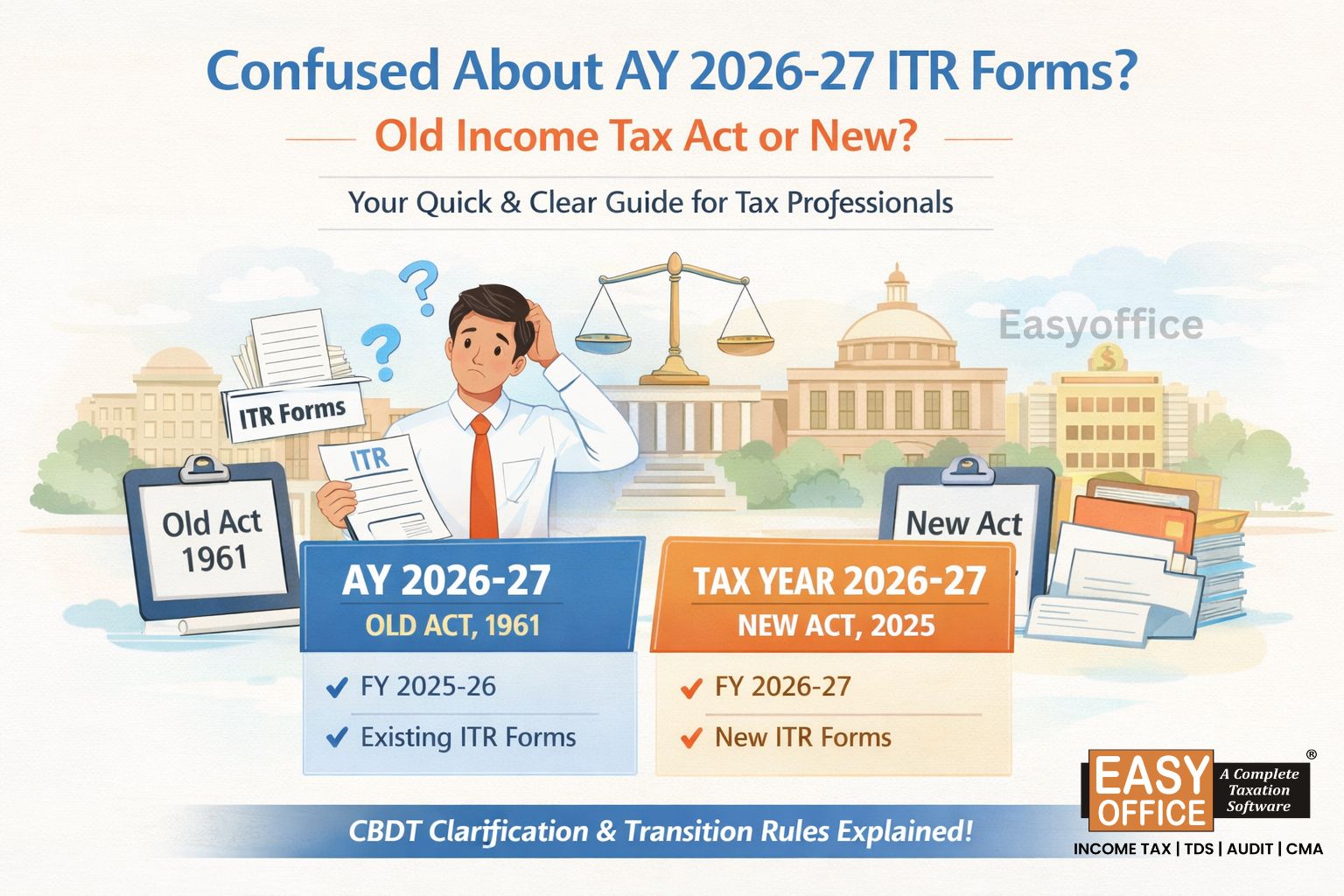
Under the earlier Income-tax Act, 1961, eligible taxpayers used Form 15G or Form 15H, depending on their circumstances. From Tax Year 2026-27, the Income-tax Act, 2025 introduces Form No. 121, which replaces these two forms with a single declaration.
This guide provides information about eligibility requirements, deadlines, filing procedures, and the latest budget changes, which simplify submissions for the coming years.
What Are Form 15G and Form 15H? What Is Form 121?
Financial institutions, including banks, NBFCs, insurance companies, companies and mutual funds, use Form 15G and Form 15H for declarations. This states that your total estimated income for the financial year results in zero tax liability.
Form 15G → For resident individuals below 60, HUFs and trusts
Form 15H → For resident senior citizens aged 60+
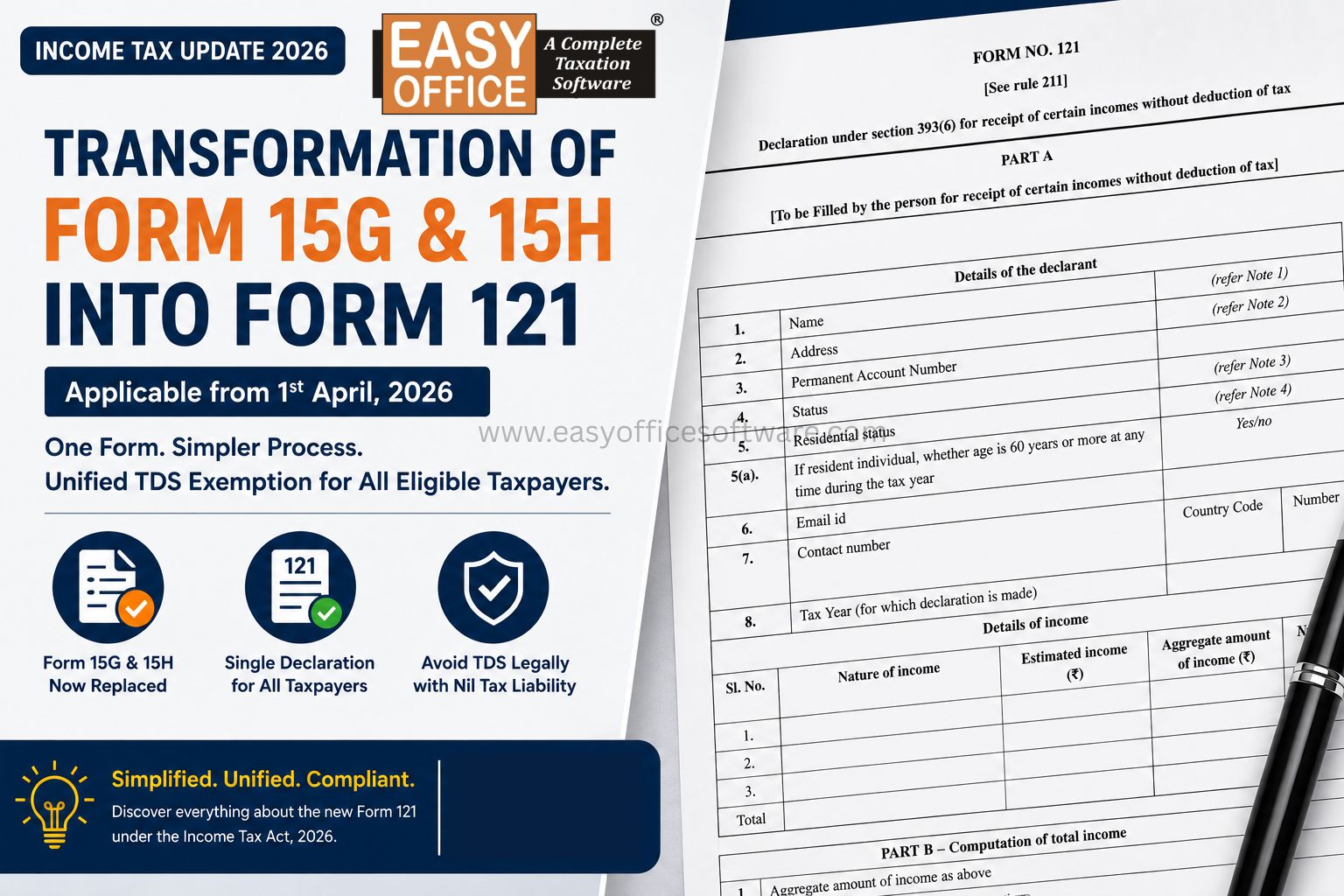
From Tax Year 2026-27, Form No. 121 under Section 393(6) and the relevant provisions of the Income-tax Act, 2025 replaces the two forms.
The purpose remains similar: an eligible recipient declares that the tax liability on estimated total income for the relevant tax year is nil, allowing the payer to consider non-deduction of TDS on covered income.
Once the forms are submitted and approved, no TDS will be deducted on eligible payments for the rest of the financial year/ Tax year.
Why Are These Declaration Important?
TDS deduction begins automatically when your income reaches the limit under Sections 192A, 193, 194, 194A, 194D, 194DA, 194I, and 194K or New section as per Act 2025. The TDS deductions do not consider your applicable deductions, rebates and tax-free limits.
These declarations can be useful:
Even with nil tax liability, TDS may still be deducted.
Filing 15G and 15H forms or Form 121 stops cash flow problems, especially for senior citizens.
Avoids the long wait of claiming TDS refunds via ITR.
However, Form 15G, Form 15H or Form 121 must not be used unless the taxpayer meets the relevant eligibility requirements. A nil tax calculation by itself does not mean every category of payment qualifies for a declaration.
Eligibility Conditions Explained
✔ Eligibility for Form 121 (TY 2026-27)
Form 121 combines the earlier declaration Forms 15G and 15H.
i. Resident Individuals below 60 and other eligible persons: Nil tax liability and the aggregate of the specified income covered by the declaration not exceeding Basic Exemption limit
ii. Resident senior citizens aged 60 or above: Tax liability is nil, even if your total income exceeds the basic exemption limit
✔ Eligibility for Form 15G
You can submit Form 15G if:
i. You are a resident Indian
ii. You are below 60 years old
iii. Your total estimated income is below the exemption limit
iv. Tax payable is zero
v. You have a valid PAN
Not permitted for: (i) Companies (ii) Partnership firms (iii) Non-residents
✔ Eligibility for Form 15H
You can submit Form 15H if:
i. You are a resident senior citizen (60+)
ii. Your tax liability is nil, even if your total income exceeds the basic exemption
iii. You have a valid PAN
HUFs and non-residents cannot file Form 15H.
Key Differences Between Form 121 , Form 15G and Form 15H
| Criteria | Form 121 | Form 15G | Form 15H |
| Applicability | From Tax Year 2026-27 (TY 2026-27) | Till Financial Year 2025-26 (AY 2026-27) | Till Financial Year 2025-26 (AY 2026-27) |
| Applicable Framework | Income-tax Act, 2025 | Income-tax Act, 1961 | Income-tax Act, 1961 |
| Purpose | Single declaration replacing both forms | Declaration for eligible income | Declaration for eligible income |
| Age | No separate form based on age | Below 60 years (for individuals) | 60 years or above |
| Eligible entities | As per new provisions | Resident Individuals, HUFs, Trusts | Resident Individuals only |
| Income condition | Conditions depend on age and specified income | Must be below the exemption limit | Can exceed the exemption limit |
| Tax liability | Must be nil | Must be nil | Must be nil |
| Residential status | Resident only | Resident only | Resident only |
Which Types of Income Can Be Covered?
The declaration is available only for some income categories. Depending on the provision and the payer/payee relationship, covered categories may include:
i. Interest on bank deposits and other specified interest.
ii. Interest on securities.
iii. Certain dividend income.
iv. Eligible income from specified mutual fund or investment units.
v. Certain insurance-policy payments or insurance commission.
vi. Specified rent payments.
vii. Eligible accumulated provident fund balances.
Not every payment in these categories automatically qualifies. The TDS provision, threshold, nature of payment, recipient's status and declaration conditions must all be checked.
For Tax Year 2026–27, refer to Form 121 and the Income-tax Act, 2025. When explaining older transactions or the earlier tax framework, refer to the relevant provisions of the Income-tax Act, 1961.
Do not rely on the TDS threshold alone to decide eligibility. Confirm that the declaration is permitted for the particular income and that all conditions are satisfied.
📢 Budget 2026 Amendment: What Has Changed?
The budget 2026 implementation has introduced a significant compliance relief effective from 1 April 2027.
🔹 Single-Form Filing Through Depositories
Instead of submitting multiple copies of Form 121 to banks, mutual funds and companies:
The depository system now allows you to submit one Form 15G or Form 15H through your depository account at NSDL or CDSL.
👉 You will now be able to submit a single Form 121 via your depository .
The depository will automatically:
Confirm your PAN
Map your declaration to all securities/investments
Share it electronically with all payers
Ensure uniform, centralized TDS exemption
The Impact of this Update
• No repeated submissions for FDs, dividends, bond interest, etc.
• Investors who hold portfolios at different institutions find this process easier to handle.
• It prevents clerical mistakes while speeding up the process of submitting documents.
• Ensures TDS exemptions across all linked investments
Due Dates & Validity
• Form 15G and 15H or Form 121 must be submitted every financial/ Tax year.
• The best time to submit the document occurs at the beginning of the financial year.
Your late submission will result in:
· TDS already deducted cannot be undone
· You will need to claim a refund through ITR
Some banks also accept submissions quarter-wise, especially for recurring deposits and FD interest.
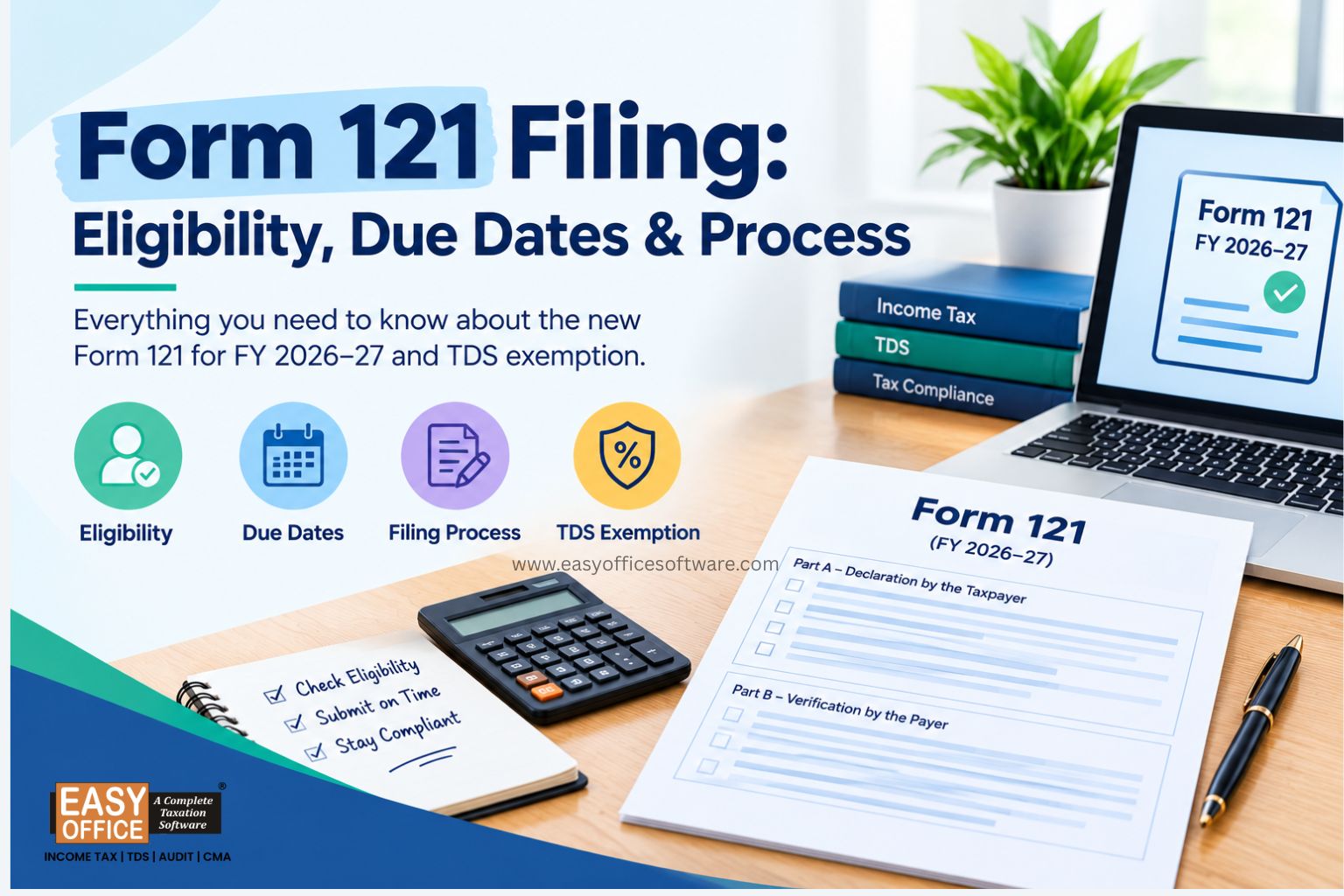
What Details Are Required in Form 121?
Under the current framework, Form 121 has two main parts.
Part A – Declaration by the taxpayer
Contains:
Name
PAN
Address
Income details
Estimated total income
Declaration of nil tax liability
Part B – Verification by the payer
This part records the payer's receipt and verification of the declaration and supports the applicable reporting and compliance process. Contains: TAN, PAN, Nature & amount of income, Date of submission
Step-by-Step Filing Process
Online Filing
1. Log in to your bank / NBFC / financial institution’s net banking
2. Select Form 121 or 15G/15H submission
3. Choose the FD, RD, or relevant income source
4. Fill personal & income details
5. Verify using OTP
6. Save the acknowledgement
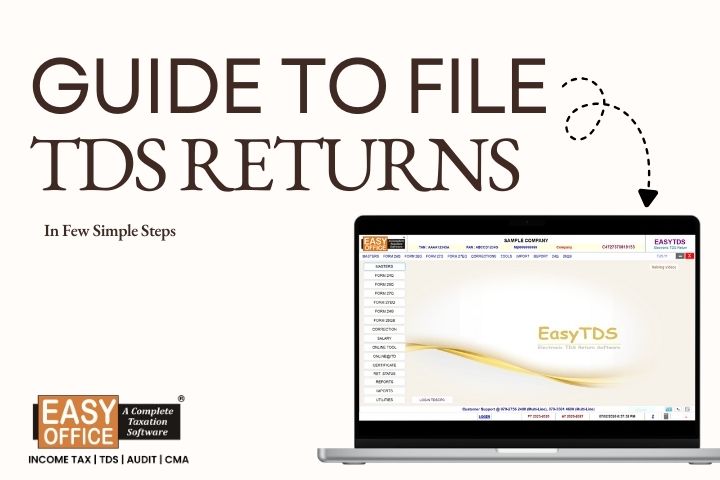
Using TDS Software (EasyTDS)
If you handle multiple declarations:
EasyTDS auto-validates PAN details
Tracks approval status
Links declaration to payments
Auto-updates TDS returns
Minimizes manual errors & compliance risks
This is especially useful for:
Banks
Large corporates
Accountants
Tax professionals
Entities filing bulk returns
What Happens After Submission?
Once submitted:
· The bank verifies your declaration after your submission.
· TDS won’t be deducted for that financial year if the approval is granted.
· You should check statements to verify compliance with the rules.
How TDS Software Simplifies Form 121 or 15G/15H Compliance
Manual tracking of declarations creates organizational risks such as:
PAN mismatches
Missed linking of forms
Incorrect TDS returns
Audit discrepancies
EasyTDS is the best TDS software and the right TDS filing module of the EasyOFFICE suite that ensures:
1. Automated PAN verification
2. Centralized declaration management
3. Accurate mapping of forms to payments
4. Seamless TDS return generation
5. Reduced compliance gaps and errors
EasyTDS serves as the most dependable TDS and TCS return filing software for companies, banks and tax professionals. It is an all-in-one solution that handles validation, reporting and filing tasks.
Final Words
Form 121 (Earlier Form 15G/15H) stop TDS deductions, especially when your tax liability is nil. The Budget 2026 amendment has simplified taxpayers' filing process, enabling them to submit their investment declarations through depositories beginning April 2027.
If you’re a company or individual CA handling multiple declarations, the process of manual tracking can create compliance issues. But having a reliable TDS software can fill these compliance gaps.
Our EasyTDS software provides accurate results through its accuracy, speed, and complete regulatory adherence.
Frequently Asked Questions
1. Are Forms 15G and 15H still used in Tax Year 2026-27?
For tax years beginning on or after 1 April 2026, Form 121 is prescribed under the Income-tax Act, 2025 in place of Forms 15G and 15H. The earlier forms applicable till FY 2025-26.
2. What is Form 121?
Form 121 is a declaration under Section 393(6) of the Income-tax Act, 2025. Eligible taxpayers use it to request non-deduction of TDS on specified income where the prescribed conditions are met.
3. Can a senior citizen submit the declaration if income exceeds the basic exemption limit?
A resident senior citizen may qualify even if income exceeds the basic exemption limit, provided that tax on estimated total income is nil.
4. Is Form 121 valid for every type of income?
No. It applies only to specified income categories and eligible payer/payee relationships. The taxpayer must confirm that the particular payment is covered.
5. When should Form 121 be submitted?
It is preferable to submit the declaration at the start of the tax year and before the relevant income is credited or paid. Submit it separately to each relevant payer unless an expressly permitted alternative route applies.
Form 121, Form 15G, Form 15H, TDS Exemption, Income Tax India,
Related Blogs

All in one Software
- Income Tax Software
- TDS & TCS Software
- Audit e-filing Software
- CMA Data Software









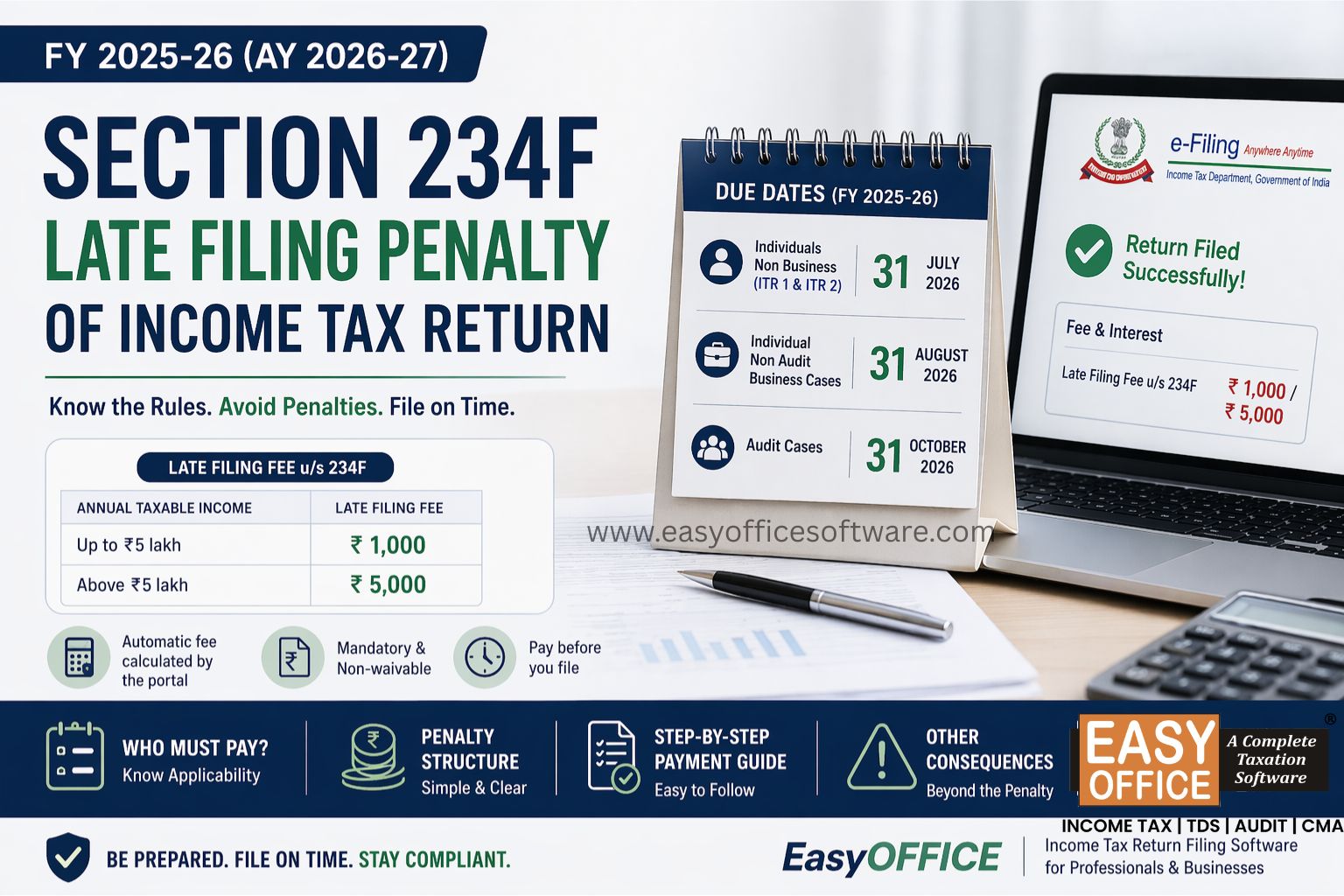
Penalty for Late Filing of Income Tax Return for FY 2025-26 – Section 234F of Income Tax Act 1961
#ITR