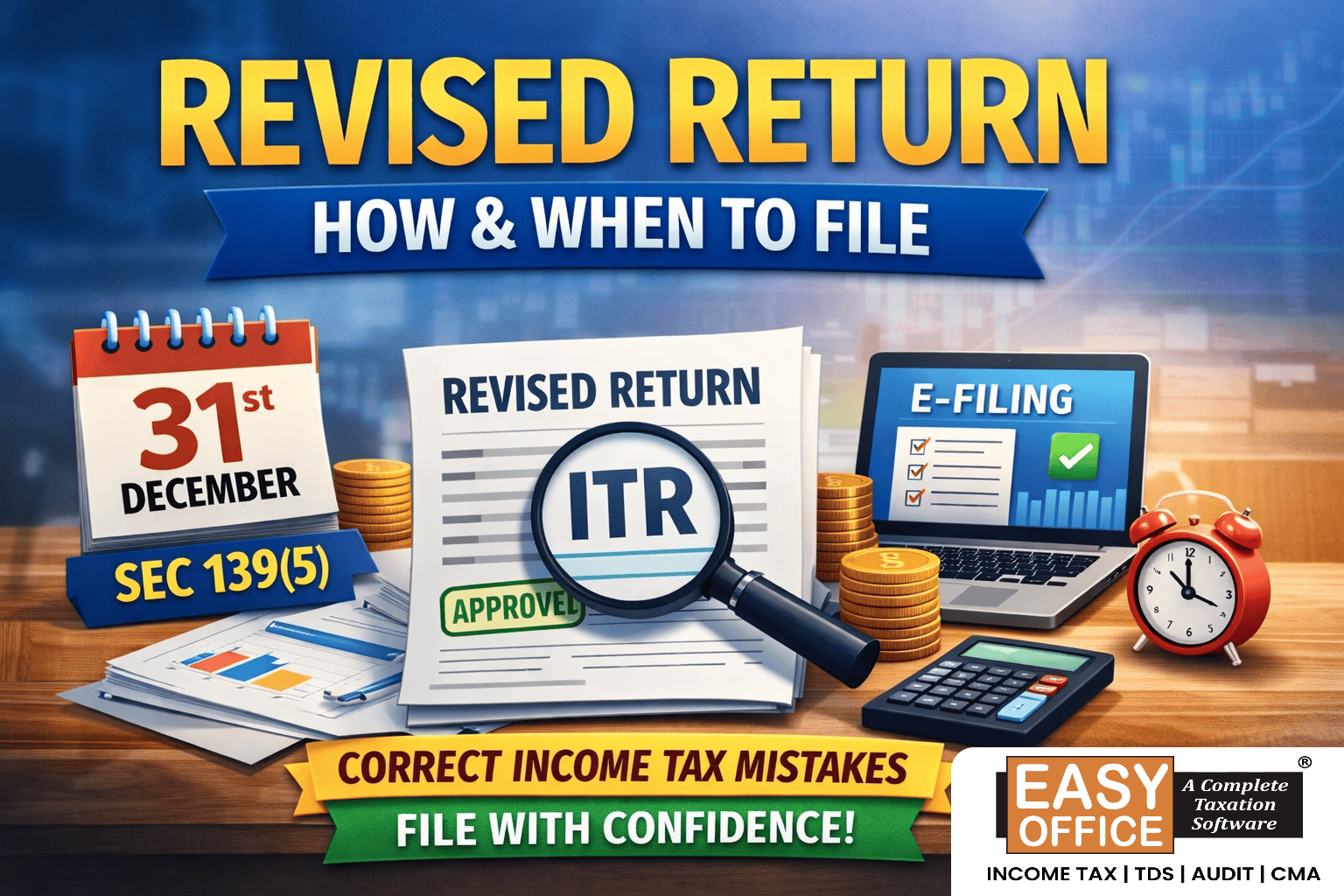
Even taxpayers with the most discipline are liable to make errors. Missing a deduction, failing to report an income entry, entering a wrong amount, or even choosing the wrong form can all happen unnoticed until filing your return. The silver lining is that the Income Tax Act, 1961, offers you a straightforward way to rectify these errors with a revised return under Section 139(5).
Most individuals and professionals are not aware of how easy the revision process can be, particularly if they use digital tools or reputable income tax return filing software that is error-free and compliant.
In this article, we will discuss what a revised return is, the right time to file one, and the step-by-step instructions to do it.
What Is a Revised Return?
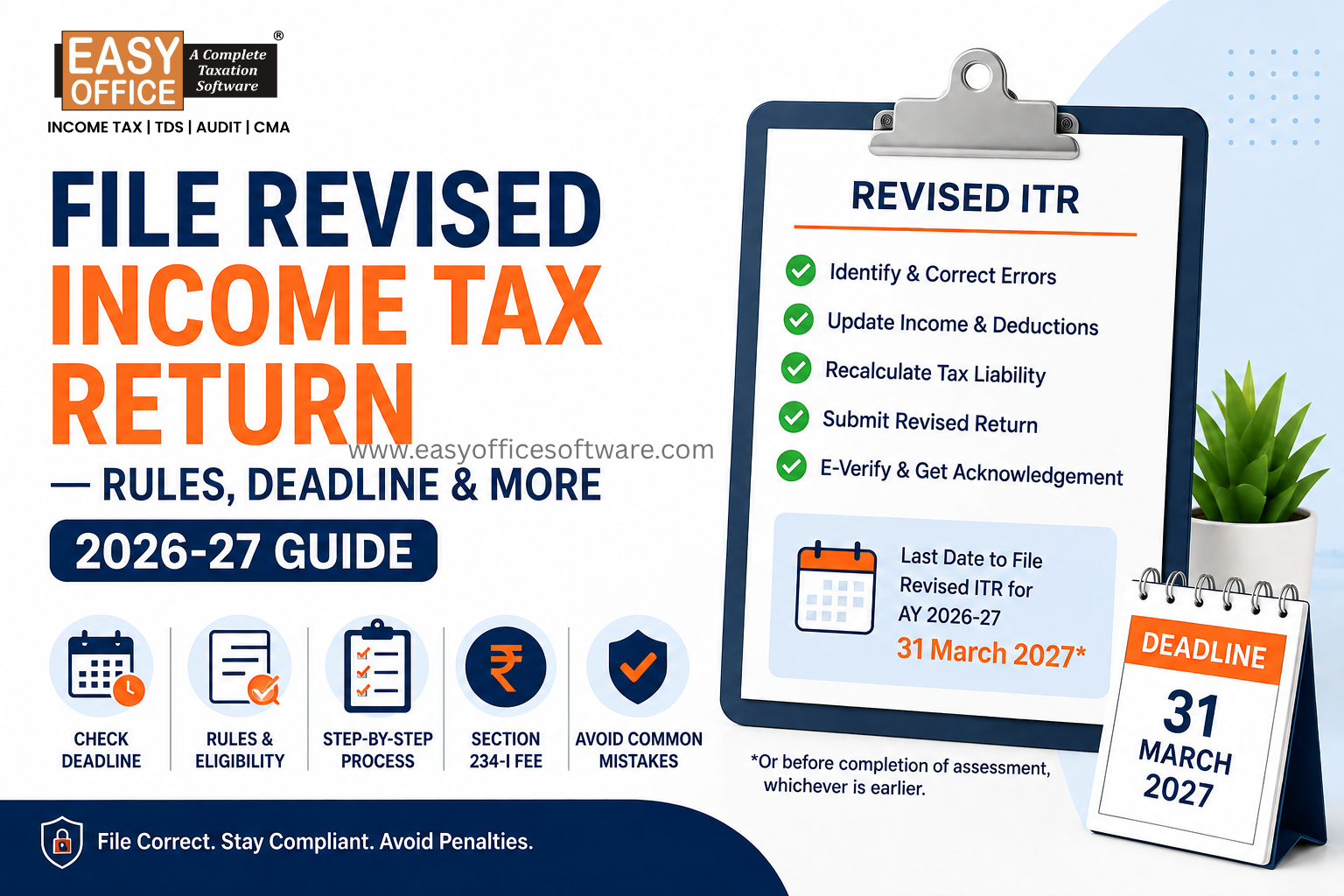
A revised return is a re-filing of your income tax return by revising your originally filed income tax return. If you realize that you have failed to report an income, selected the incorrect tax regime, omitted a deduction, entered wrong figures, or used the wrong ITR form, then you have the option of fixing all these issues under Section 139(5) within the timeline allowed. After the submission, your revised return takes the place of your original return. It is the final return for that fiscal year.
Common errors that can be rectified through a revised return include:
• Freelance or salaried income that was not reported
• Interest income that was not reported
• Deductions that were either under-reported or over-claimed
• Incorrect calculation
• Wrong ITR form being used
• Wrong tax regime selection (Old vs New)
• Refunds not being claimed
• TDS/TCS Credit Not claimed Correctly
Through the revision of returns, it becomes a certainty that your documentations are in line with Form 26AS, AIS, and your financial statements at the bank. Moreover, it leads to a lower probability of scrutiny notices or a longer duration of refund waiting time.
When Should You File a Revised Return?
The filing of a revised return must be done by the last date of 31st December of the Assessment Year, provided the assessment has not been completed by the tax department.
For example:
For FY 2024–25 (AY 2025–26), the last date to revise is 31st December 2025.
You are allowed to revise the return multiple times. There is no limit imposed by the law on the number of revisions, but it is advisable to maintain accuracy in each revision.
Importantly, even belated returns can be revised. This gives taxpayers a greater time span to correct their errors. Nevertheless, the revised return does not eliminate the penalties that were imposed for initially filing late.
Income Tax return filing software and similar tools can assist you in spotting both the deadlines and the errors at an early stage, allowing you to correct the situation much before the set date.
Budget 2026 Proposed Changes: Extended Time Limit for Filing Revised Returns
Under the existing law, a revised return must be submitted within nine months after the conclusion of their applicable tax year, which ends on December 31 of the Assessment Year. Budget 2026 proposes to extend this period to twelve months (31st March) from the end of the relevant year. This provides taxpayers with additional time to fix their mistakes and missing information. A graded fee may apply if the revisions remain unfiled until after nine months of the initial submission.
Key Rules You Must Know Before Filing a Revised Return
I. Revised return replaces the original
Your revised return is regarded as official and final upon its submission.
II. Revision allowed even after refund received
Even if you have already been issued a refund, you can still correct your return before the due date.
III. Multiple revisions are allowed.
You may make necessary revisions numerous times during the allowed period.
IV. Cannot revise after assessment
The facility to revise is lost once the Assessing Officer finishes Assessment under Section 143(3).
V. No penalty for revising
If the initial return was filed within the time limit, then there is no punishment for submitting a revised return.
VI. Update tax details accurately
Before you make amendments, be sure to compare Form 26AS, AIS, TIS, and your bank statements.
Many taxpayers are using the Income tax return filing software, as it minimizes the chance of mismatch errors and helps identify missing disclosures early.
How to File a Revised Return
You are allowed to submit a revised return, whether the original return was filed with the help of a professional tool, through a private platform, or directly on the Income Tax portal.
Here is the step-by-step process:
1. Go to the official income tax e-filing website
2. Sign in using your PAN and password
3. Click on e-File → Income Tax Return → File Revised Return
4. Select the right assessment year
5. Choose the right ITR form
6. Provide your original ITR acknowledgment number and date of filing
7. Make the necessary adjustments
8. File the revised return
9. Carry out e-verification using Aadhaar OTP, net banking, or EVC
The revised return is deemed invalid unless e-verification is completed
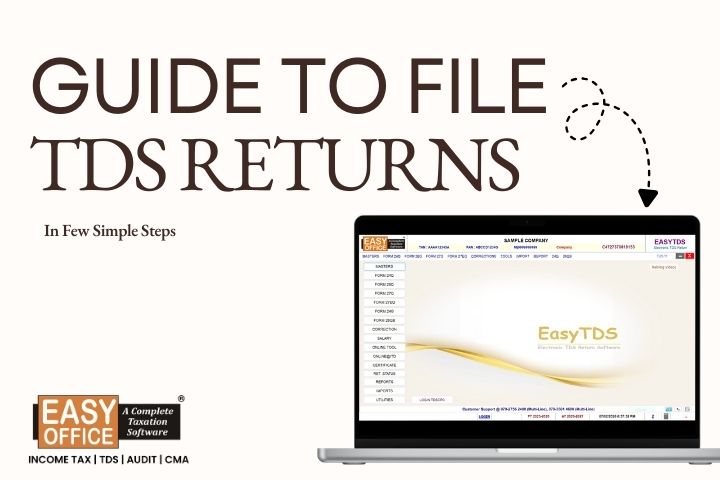
If you are using taxation software such as EasyOFFICE Income Tax Software, many fields will automatically get filled based on your earlier filings and Return will be filed directly from software within few minutes. This eliminates the risk and saves time.
Is There a Penalty for Filing a Revised Return?
If you are within the permitted period for filing a revised return, there will be no separate penalty. But:
• If the original return was late, you have to pay the late fee as per Section 234F.
• If the revised return shows that you owe more taxes, then interest will be applicable.
• Revising does not get rid of past violations like late filing.
A revised return is for making changes, not for escaping penalties.
Why Using Income Tax Return Filing Software Helps
Currently Taxation software used by professionals and businesses often includes integrated tools for ITR preparation, reconciliation, reporting, and revision/Updated Return. Indian taxpayers, especially CA’s and Tax Professions, prefer using such software for:
1. Auto-import of previous year data
2. Pre-fill JSON Import
3. Matching income with Form 26AS and AIS
4. Old Tax v/s New Tax Regime Comparison
5. Automatic error detection
6. Auto ITR form selection
7. Auto Calculation of Taxes, Interest and Penalties
8. Tracking deadlines
9. Direct filing and e-verification
Using the best Income Tax return filing software helps reduce human errors, provides timely alerts, and makes revisions seamless.
Revise Smart, File Confidently
A corrected return indicates adherence to the rules. It signifies precision, transparency, and accountability. A correction of return safeguards you from queries, guarantees correct tax liability, and enables you to receive your refunds without any hassle.
If you desire a straightforward and immaculate tax filing process, opt for EasyOFFICE Income Tax Return Filing Software by ELECTROCOM. Our software is one of the top choices for chartered accountants, tax professionals, and enterprises in India for the easiest Income Tax return filing. Designed for ease and accuracy, EasyOFFICE provides you with the comprehension you require before submitting or altering your returns.
Pick EasyOFFICE and enjoy smooth filing at all times.
Frequently Asked Questions
1. Can I revise my return after getting a refund?
Sure, you can do the modifications as long as it is before 31st December of the Assessment Year (Due Date).
2. How many times is it possible to change my ITR?
There is no limit at all. If you feel it is necessary, you can even revise a number of times.
3. Can a belated return be revised?
Yes. A belated return can also be totally revised within the revision time frame.
4. Will there be a penalty for submitting a revised return?
No penalty if you submit during the allowed times. Still, the late submission of the original return attracts a penalty.
5. What are the particulars needed for revising my return?
Your original acknowledgement number, date of original filing, corrected income details, and updated tax records such as 26AS and AIS.
6. What is the Due date to File Revised Return?
Revised return can be filed up to 31st December of the Assessment Year, or before completion of assessment, whichever is earlier.
Revised Return, Income Tax India, ITR Filing, Tax Compliance, Income Tax Guide, Tax Filing Process, Indian Taxation
Related Blogs



All in one Software
- Income Tax Software
- TDS & TCS Software
- Audit e-filing Software
- CMA Data Software








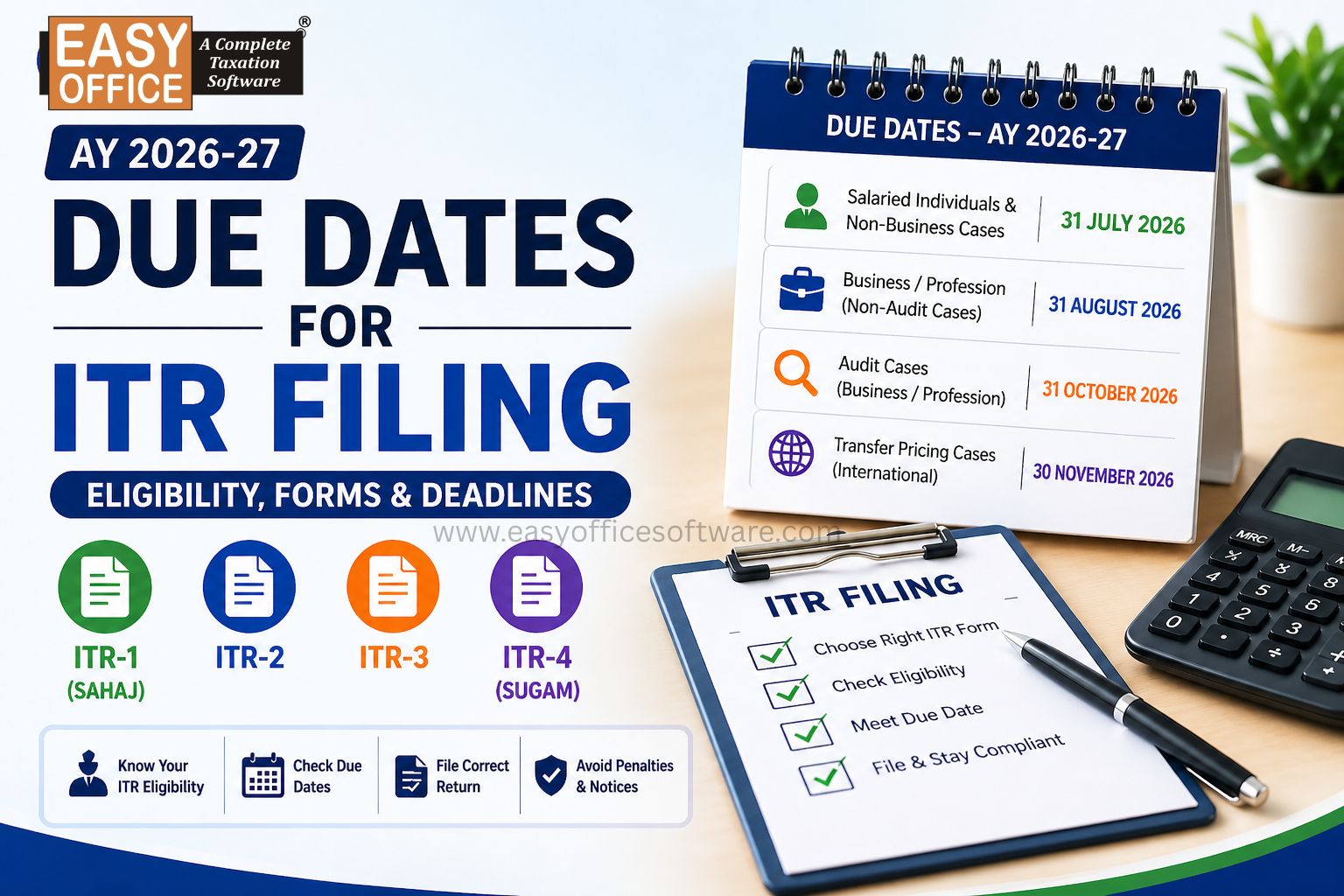
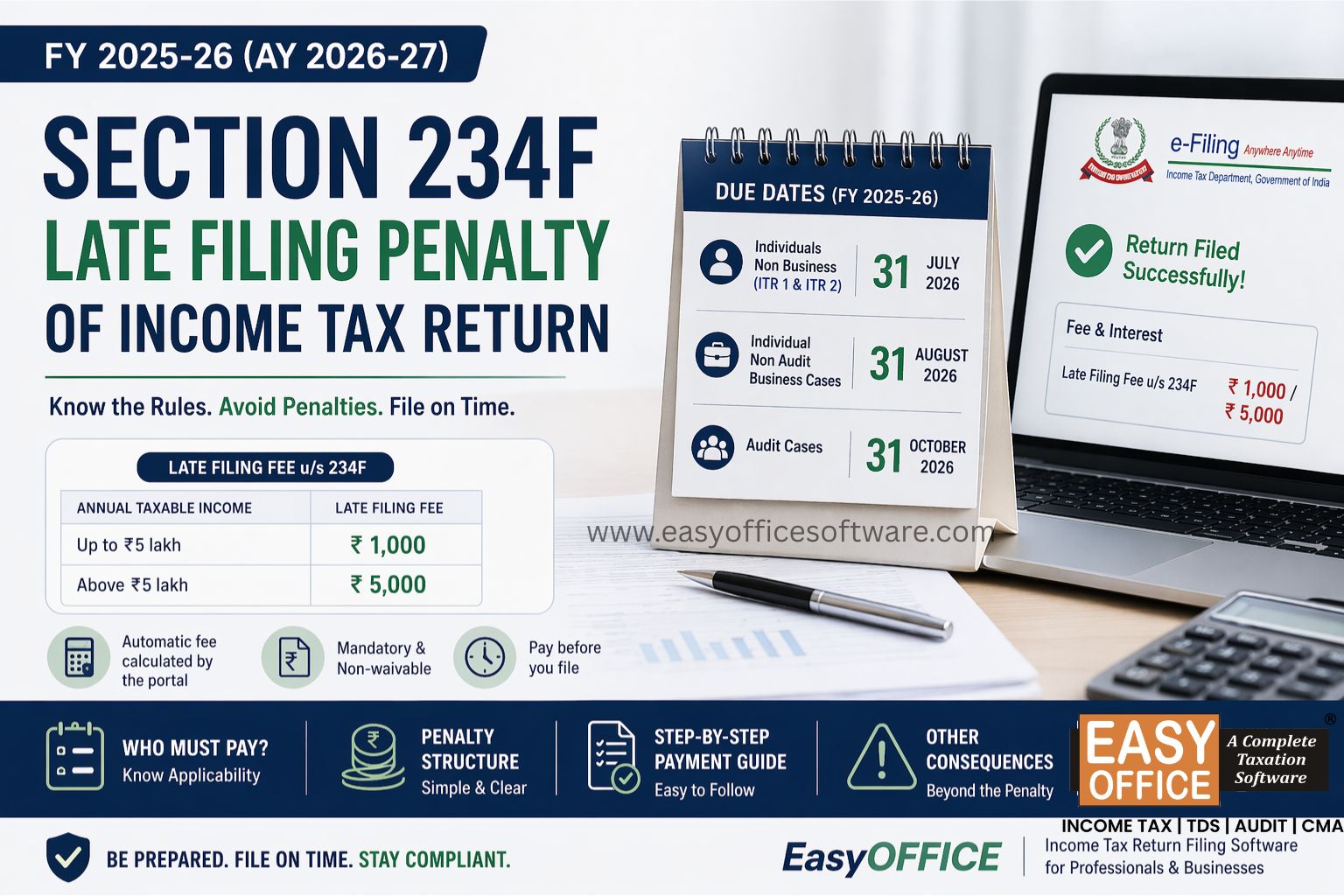
Penalty for Late Filing of Income Tax Return for FY 2025-26 – Section 234F of Income Tax Act 1961
#ITR