Do your annual GST figure you report match your audited financial statements?
If the tax agency questions the differences, are you all set?
That is precisely the point where GSTR-9C becomes crucial.
For Indian businesses and tax professionals, GSTR-9C is more than just a compliance form. It is confirmation that the GST returns filed by applicable taxpayers during the year correspond to the audited financial statements. If done right, it reduces notices, saves from penalties, and gives more credibility to compliance.
This handbook presents GSTR-9C in a simple, useful way, discussing the aspects of applicability, due date, format, penalties, and how the right GST reconciliation software can ease the process.
What Is GSTR-9C?
GSTR-9C is a yearly GST reconciliation statement. It makes the comparison of the amounts reported in:
1. GSTR-9 (Annual Return)
2. Audited annual financial statements
The purpose is to spot differences in sales, taxes, and Input Tax Credit (ITC), explain reasons, and disclose any additional tax liability.
Key points that are important to grasp:
1. GST returns are filed according to GSTIN and not PAN
2. Applicable to taxpayers exceeding the limit set by the government
3. Prepared and self-certified by the taxpayer
4. Submitted along with the audited financial statements
GSTR-9C serves as a link between the accounting records and the GST return filings.
Who Is Required to File GSTR-9C?
The applicability of GSTR-9C is determined by the annual turnover.
You must file GSTR-9C in cases:
> You are a GST-registered taxpayer
> You have an aggregate turnover exceeding ₹5 crore in a financial year
According to the CBIC Notification No. 30/2021, the threshold of ₹5 crore applies equally to all the regions of India.
The following are the exemptions:
> Taxpayers who are Not Required to File GSTR-9
> Foreign airline companies that are covered under the Companies Act, not required to file GSTR-9, hence GSTR-9C is not applicable.
> Non-resident taxpayers who are providing OIDAR services to unregistered people, as they are required to file GSTR-5A and not GSTR-9.
You don’t need to file GSTR-9C if your turnover is less than ₹5 crore.
Click Now >> How to File GSTR 9C by EasyGST
GSTR-9C Due Date
GSTR-9C has the same due date as GSTR-9.
> 31st December of the year after the relevant financial year
> For instance:
> FY 2024-25 → Due date: 31st December 2025
There are possibilities of deadline extensions; however, firms need to prepare according to the standard due date to mitigate the risks of rushing things at the last moment.
Structure and Format of GSTR-9C
GSTR-9C is divided into two major parts. Part A presents a detailed Reconciliation Statement where the amounts reported in the annual GST return are compared with the figures in the audited financial statements. The second Part B deals with the Self Certification that confirms the accuracy of the reconciliation.
Part A: Reconciliation Statement
It comprises five parts:
Part I – Basic Details
GSTIN, financial year, trade name, audit status
Part II – Reconciliation of Turnover
A comparative analysis of the difference between the audited turnover and the GSTR-9 turnover, along with justifications
Part III – Reconciliation of Tax Paid
Aligning tax liability with tax paid
Part IV – Reconciliation of Input Tax Credit
ITC, according to the books, versus ITC claimed in the returns
Part V – Additional Liability
Any tax, interest, or ITC reversal payable due to mismatches
If additional liabilities arise, payment has to be made through Form DRC-03.
Part B: Certification in GSTR-9C
Currently Only taxpayer self-certification is sufficient and it is proof of the correctness of the reconciliation
Self-certification is allowed, but still, accuracy is still very important because wrong reporting may lead to audits or notices. So, it is advisable to use the best GST reconciliation software to file with accuracy and precision.
Penalty for Late or Non-Filing
Penalty for Late or Non-Filing
The due date for filing is accompanied by fines according to the law:
i. ₹200 for each day of the delay (₹100 for CGST + ₹100 for SGST)
ii. The highest penalty is limited to 0.5% of the sales in the state or UT
>> The late fee for GSTR 9C will be calculated from date of filing of GSTR 9 or due date of filing of Annual return, whichever is later till the filling of GSTR-9C.
Using automated reconciliation tools reduces the risk of delay and calculation errors.
Common Challenges in GSTR-9C Filing
Filing GSTR-9C is often seen as a trouble and a challenge for taxpayers. The most common issues are:
- Canceling GSTIN-related reconciliations with PAN-level accounting
- ITC discrepancies caused by changes or cancellations
- Errors in manual Excel
- Keeping an eye on the adjustments across multiple returns
The solution to the above problems is to use our EasyGST reconciliation software for goods and services tax, which ensures both efficiency and accuracy.
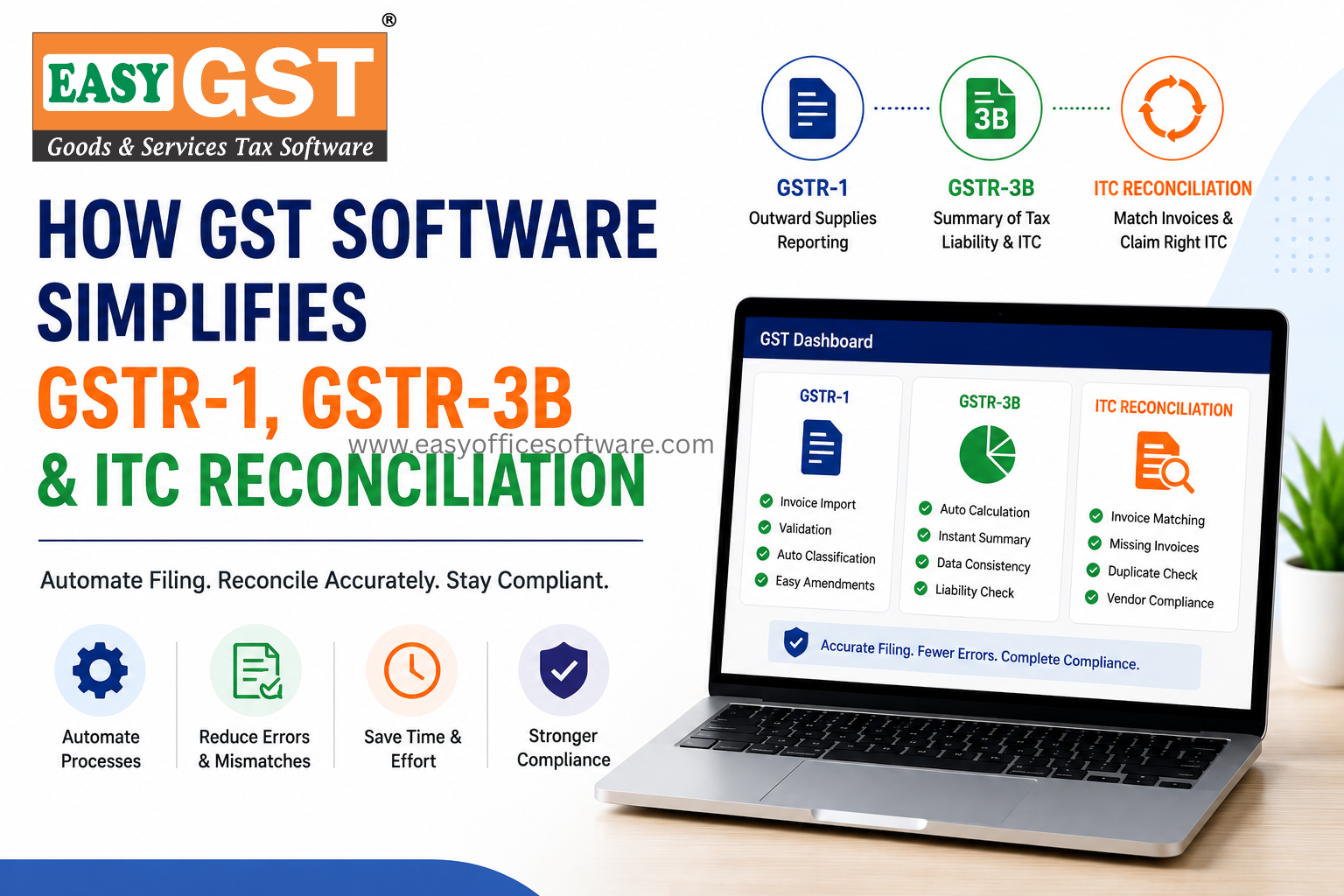
How GST Reconciliation Software Simplifies GSTR-9C
Modern reconciliation tools make it easier for the accountants and tax professionals by providing them with automated solutions that can perform complex tasks of:
- Matching GSTR-1, GSTR-3B, and books
- Instantly identifying mismatches
- Automatically preparing reconciliation tables
- Reducing reliance on manual calculations
Using dependable GST reconciliation software guarantees quicker compliance, fewer errors, and improved audit readiness. Our EasyGST software allows the CAs and tax professionals to handle numerous clients at the same time without any hassle.
Final Thoughts
GSTR-9C is a significant compliance requirement for GST taxpayers whose sales exceed ₹5 crores. Though audit financial statements and GST returns are disclosed, the precision of the tax payments is double-checked, and compliance of the businesses is ensured.
Manual management of this reconciliation is fraught with risks and takes a lot of time. Consequently, every practitioner is now employing advanced GST reconciliation software to reduce the time involved in the GSTR-9C filing process.
ELECTROCOM's EasyGST is the software solution for Chartered Accountants, tax consultants, and enterprises in India looking for fast, accurate, and effortless GST compliance.
👉 Enjoy easier GST workflows. Try out the demo of EasyGST now and complete your GSTR-9C filing before the due date!
Frequently Asked Questions (FAQs)
1. Is GSTR-9C mandatory for every taxpayer?
No. It is compulsory only for those taxpayers whose annual turnover is more than ₹5 crore.
2. Is it possible to revise GSTR-9C after submission?
No. GSTR-9C revision is not allowed once it is filed.
3. Is the CA's approval a must for GSTR-9C?
No. GSTR-9C is now going to be self-certified by the taxpayer.
4. What is the process of paying additional tax if discrepancies are identified?
Any additional tax should be paid through Form DRC-03.
5. Can GST reconciliation software be a tool to avoid penalties?
Yes. Automated reconciliation is very effective in reducing errors, delays, and compliance risks.
6. Which tables are important in GSTR-9C?
For GSTR-9C, mandatory tables are 5, 7, 9, and 12. Tables 6, 8, 10, and 13 must be filled only in case there are any unreconciled amounts according to above mentioned mandatory tables. Otherwise, those will remain blank.
Tags : GSTR 9C, GST Compliance, GST Audit, Reconciliation Statement, GST Due Dates, Indian Taxation, Chartered Accountant Guide
Related Blogs


All in one Software
- Income Tax Software
- TDS & TCS Software
- Audit e-filing Software
- CMA Data Software










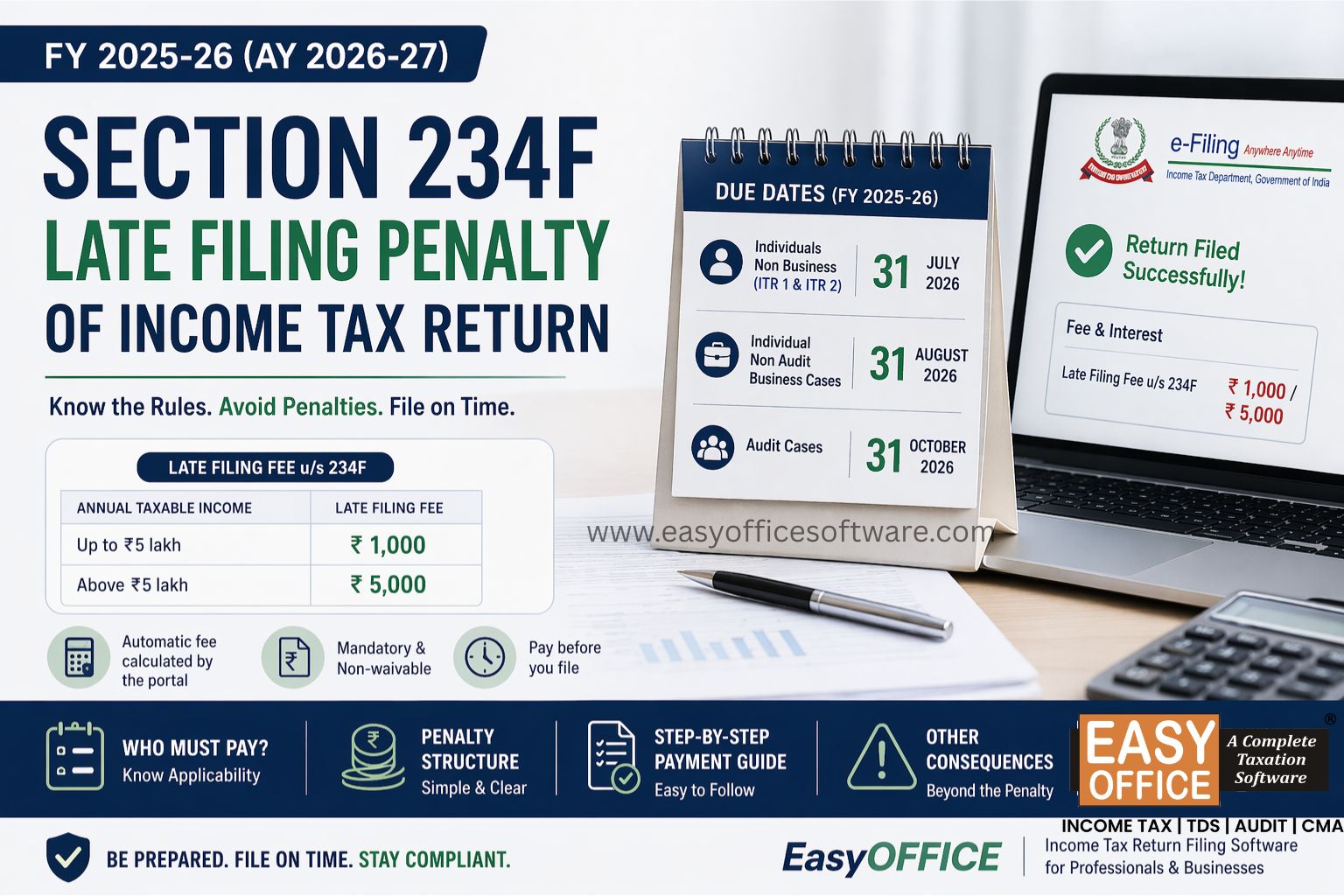
Penalty for Late Filing of Income Tax Return for FY 2025-26 – Section 234F of Income Tax Act 1961
#ITR