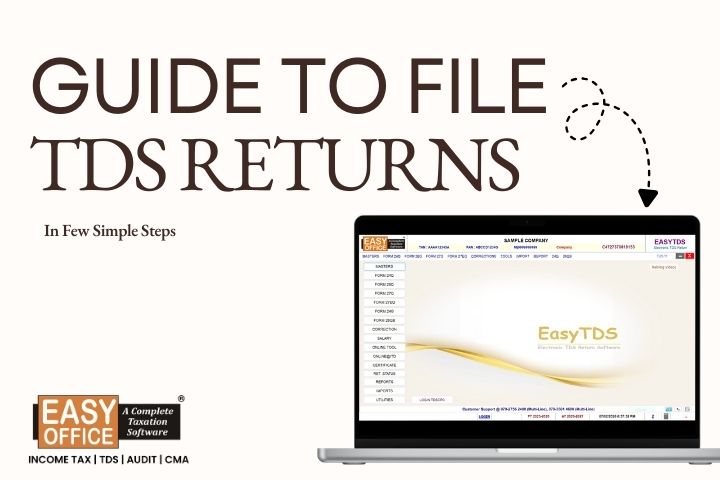
If you've ever spent an entire weekend fixing a TDS return because of one wrong PAN entry, you already know why this topic matters. TDS compliance looks simple on paper, but in practice, it's full of small details that can go wrong.
This is exactly where good TDS return filing software earns its place. It's not just about generating a return quickly. It should help you calculate TDS correctly, identifies errors before submissions and make quarterly filing less stressful.
Across India, businesses and tax professionals are dealing with increasingly digital compliance processes, tighter reporting requirements and less room for manual errors. So here's what your TDS software actually needs to have in 2026.
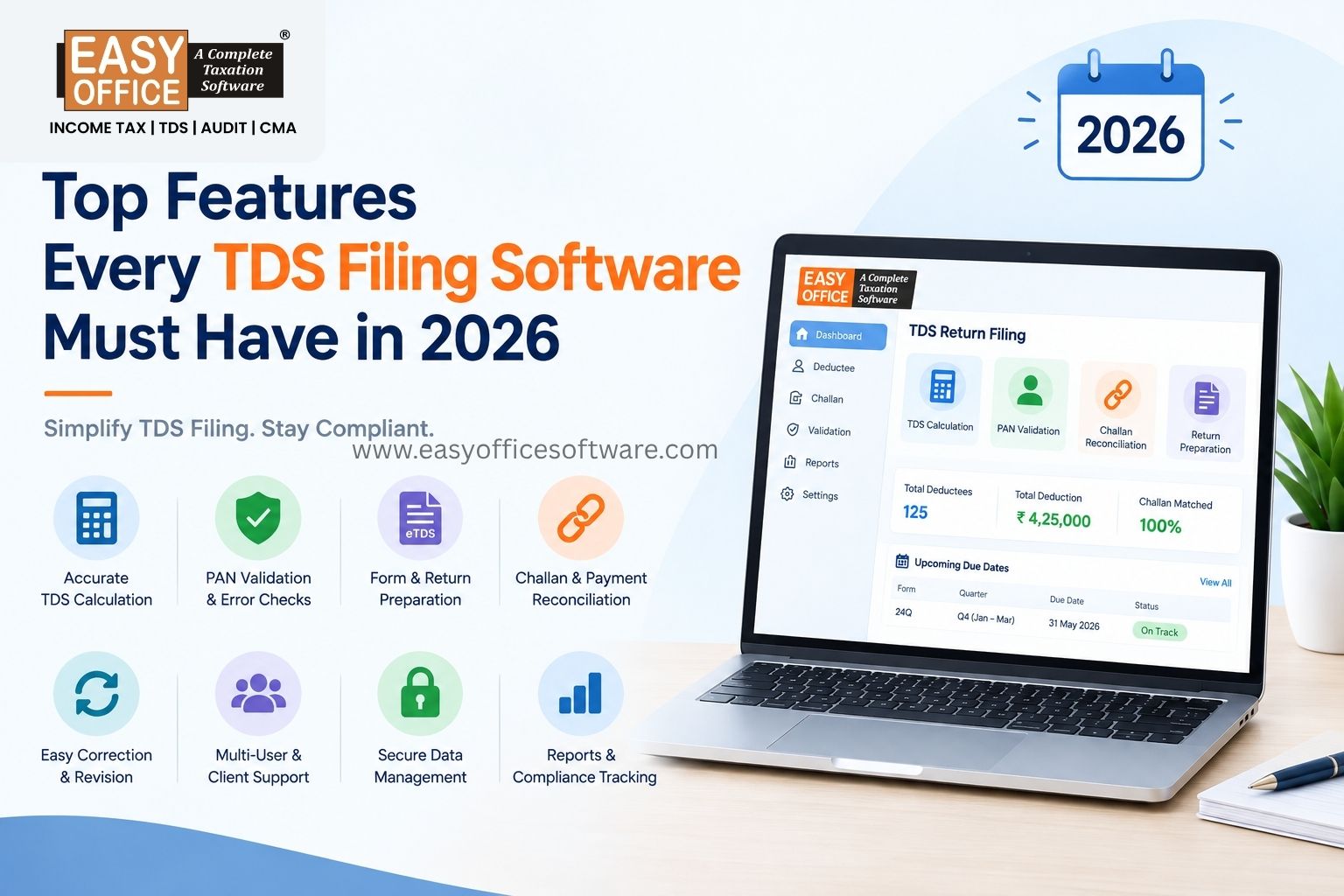
1. Accurate TDS Calculation
This is the foundation. If your software gets the calculation wrong, everything after it falls apart.
A solid system should factor in:
Nature of Payment
Nature of transaction
PAN and Deductee details
Deductee category
Applicable thresholds
Applicable provision/section under the applicable tax law
Current financial year rates
Think about a business that pays contractors, employees and landlords in the same month. Each of these has different TDS rules. Doing this by hand across hundreds of entries is where most errors creep in.
2. Automatic Data Validation
Nobody enters PAN numbers or challan details perfectly every single time. It happens to the best accountants.
That's why your TDS return filing software flag problems before you submit anything, not after you get a notice. It will be able to capture issues such as:
a. Invalid, missing or incorrect PAN details
b. Inaccurate deductee data
c. Missing or incorrect challan data
d. Incorrect deductions
e. Mismatch between deduction, challan and reported transaction details
Spotting these at the early stage prevents one from doing any rectification later on that takes much longer than the first attempt.
3. Form and Return Preparation
It should not be necessary for you to have to construct each TDS statement individually.
Good software sorts your transaction data and prepares the form in the correct format, either that of salaries or contractors or other types of deductions. This eliminates the problem of repetitive typing and minimises the possibility of making minor mistakes in formatting.
With the Income-tax Act, 2025 and Income-tax Rules, 2026 applicable from 1 April 2026, software should also support the applicable new forms and filing formats while continuing to handle correction and compliance requirements for earlier periods.
This is especially true when it comes to accountants who prepare returns for several clients at once.
4. Challan and Payment Reconciliation
Deduction of the TDS is just one part of the story. Your challan figure must also tally with the amount mentioned in the return.
Good TDS software should help you manage and reconcile::
a. TDS deduction
b. TDS deposit
c. Challan numbers
d. Payment date
e. Reported figures
The software must make sure to highlight any discrepancy rather than making you go hunting for it in your spreadsheets.
5. Easy Correction Return
Mistakes happen even to careful filers. Maybe a PAN was typed wrong, or a challan got linked to the wrong entry.
Instead of starting the whole return over, your TDS return filing software should let you correct just the affected part. An internal audit trail can also help users track what was changed and when.
6. Support for Multiple Users and Clients
If you're running an accounting practice, one business is rarely all you're managing.
Look for software that lets you handle multiple deductors and clients without their data getting mixed up. Role-based access is genuinely useful in practice; allowing data entry, review and filing responsibilities to be assigned to different users.
7. Secure Data Management
TDS records contain sensitive financial and taxpayer information, so data security should be an important consideration when selecting software. Look for:
a. Secure sign-in
b. Data encryption
c. Restrictive access
d. Data backups & Storage
e. Protection against unauthorised access
Additionally, you might want to ask the provider directly about the duration of data storage and privacy policies.
8. Reports and Compliance Tracking
Numbers on a screen don't help much unless they're organised into something readable.
A good dashboard can show pending filings, deduction summaries, challan status and upcoming deadlines at a glance. For businesses handling large transaction volumes, this single view can save hours every month.
How to File TDS Returns Online
Once your records are in order, how to file TDS returns online becomes a lot less intimidating. The basic sequence will be like this:
i. Deductee and deduction data collection
ii. PAN validation along with other details
iii. Recording and reconciling Challan information
iv. Generating an appropriate TDS statement
v. Validation and rectification of errors marked
vi. Generating the required FVU file, where applicable
vii. Filing the Form using the proper channel
viii. Tracking acceptance, rejection or processing status
ix. Keeping a copy of the acknowledgement for future reference
There can be small changes in requirements according to the nature of the deduction; hence, it is advisable to check the recent guidelines before filing.
Common Mistakes to Avoid
No software is perfect when it comes to dealing with erroneous inputs. Be wary of:
i. Wrong PAN numbers
ii. Ignoring validation messages
iii. Forgetting to reconcile your challans
iv. Missing quarterly deadlines
vi. Use of out-of-date tax rates
v. Failure to maintain supporting documents
vi. Uploading successfully does not mean that you are compliant
A small check once in a month will definitely save you from a lot of hassle.
FAQ
1. What is TDS return filing software?
TDS return filing software is a software application that helps deductors and tax professionals calculate TDS, manage deductee and challan data, validate information, prepare TDS statements and generate files required for filing and processing.
2. Why do you choose TDS return filing software over spreadsheets?
While spreadsheets can work in case of small quantities of data, the TDS return filing software can provide automated calculations, validation checks, challan reconciliation, statement preparation and correction support, particularly when transaction or client volumes increase.
3. Can TDS returns be filed online?
Yes, TDS returns are generated and filed through the appropriate online mechanism. Ensure that your information is accurate and up to date.
4. What must accountants consider when choosing TDS software?
Accuracy, validation, challan matching, correction facilities, client capabilities, reporting, security and compatibility with the latest statutory forms and filing formats.
5. Is the TDS filing software helpful for small businesses?
Yes. Even a small business which makes TDS deductions on few occasions requires well-maintained records and error-free documentation.
Conclusion
A good TDS return filing software should make TDS compliance more accurate, efficient and manageable in 2026.
Accurate calculations, validation, matching, correcting and reporting are some of those features which really save time every quarter. It's important to keep in mind the transaction volume and compliance requirements before choosing any software, rather than just thinking about prices.
There are several TDS return filing and accounting software solutions available in India. EasyofficeSoftware offers features designed to support tax professionals, CAs and businesses in their day-to-day TDS compliance.
TDS Filing Software, TDS Software, eTDS Software, TDS Return Filing
Related Blogs

All in one Software
- Income Tax Software
- TDS & TCS Software
- Audit e-filing Software
- CMA Data Software










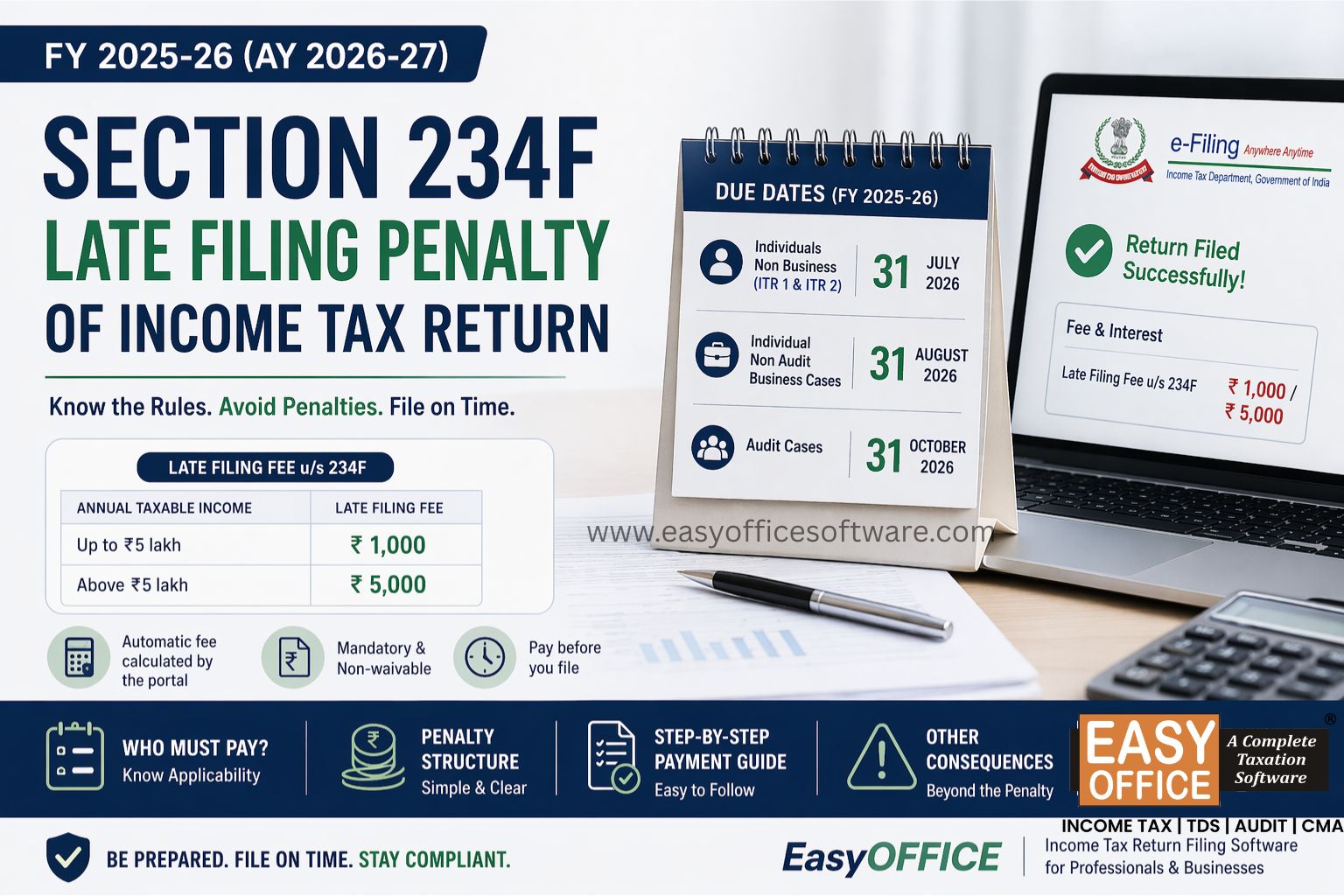
Penalty for Late Filing of Income Tax Return for FY 2025-26 – Section 234F of Income Tax Act 1961
#ITR