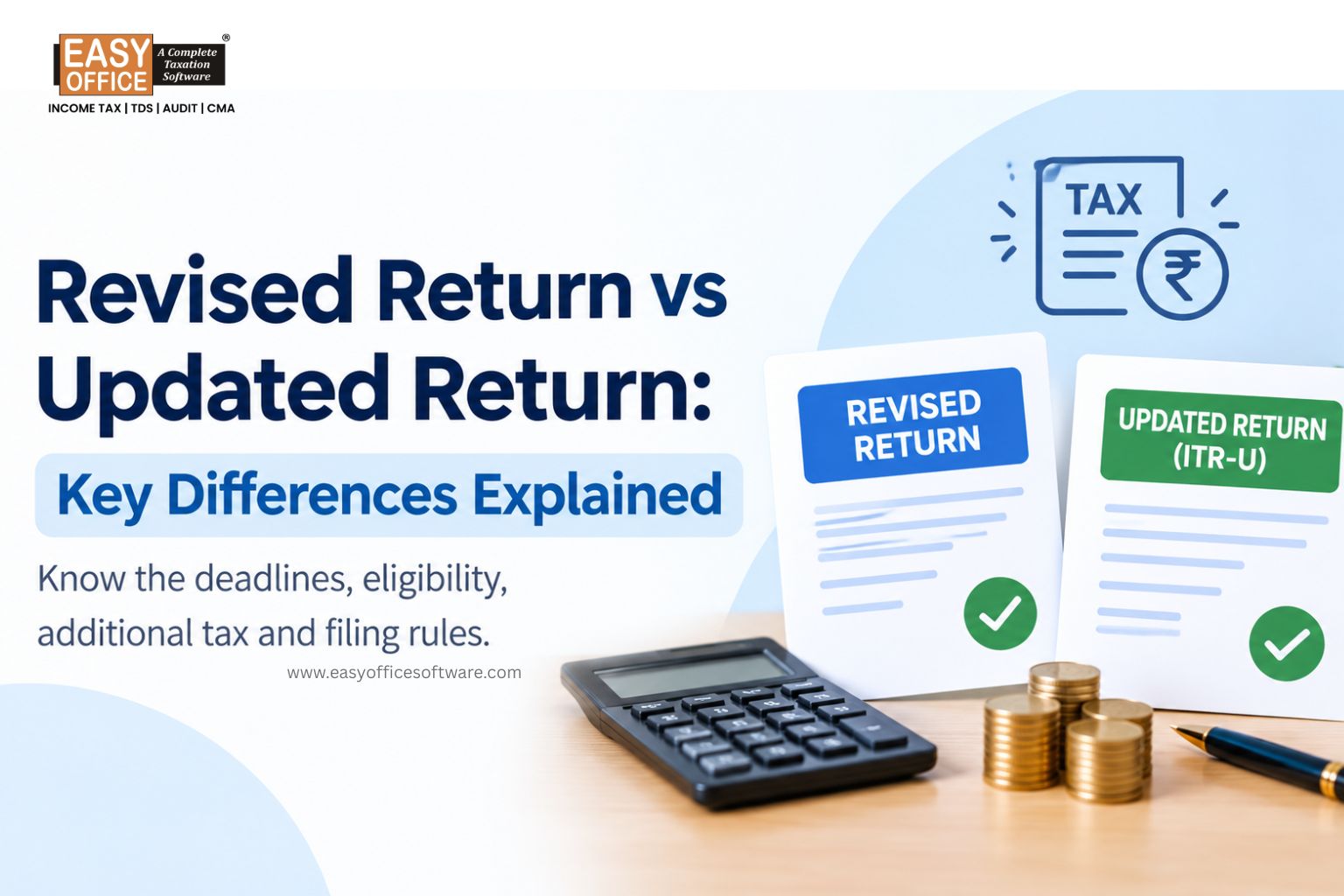
Made a mistake while filing your ITR? Don't worry, as it’s more common than you can think. The moment you fill out your Assessment Year (AY) 2026-27 return and discover a mistake, there is an easy way out for you. It’s called a revised return.
Maybe you forgot to add savings account interest, picked the wrong ITR form, or missed a deduction you were eligible for. Whatever the slip-up, reliable income tax software can help you catch these errors before you hit submit.
For AY 2026-27, there's a genuine change worth knowing: the revised return deadline has been pushed further into the assessment year. Here's everything you need to know before you file.
What Is a Revised Income Tax Return?
A revised return means nothing else but a corrected version of an already filed return.
Section 139(5) of the Income-tax Act, 1961, provides a taxpayer with the right to file a revised ITR in case of any omission, mistake or misinformation. Once validly filed and verified, this revised return takes the place of the earlier one for all processing purposes.
Taxpayers usually file a revised return to fix things like:
✔ Missed salary or other income details
✔ Overlooked interest income from a bank or fixed deposit
✔ Incorrect TDS or advance tax entries
✔ Wrong deduction or exemption claims
✔ Incorrect bank account details for the refund
✔ Income that shows up in your AIS but not in your original return
✔ Incorrect tax regime selection
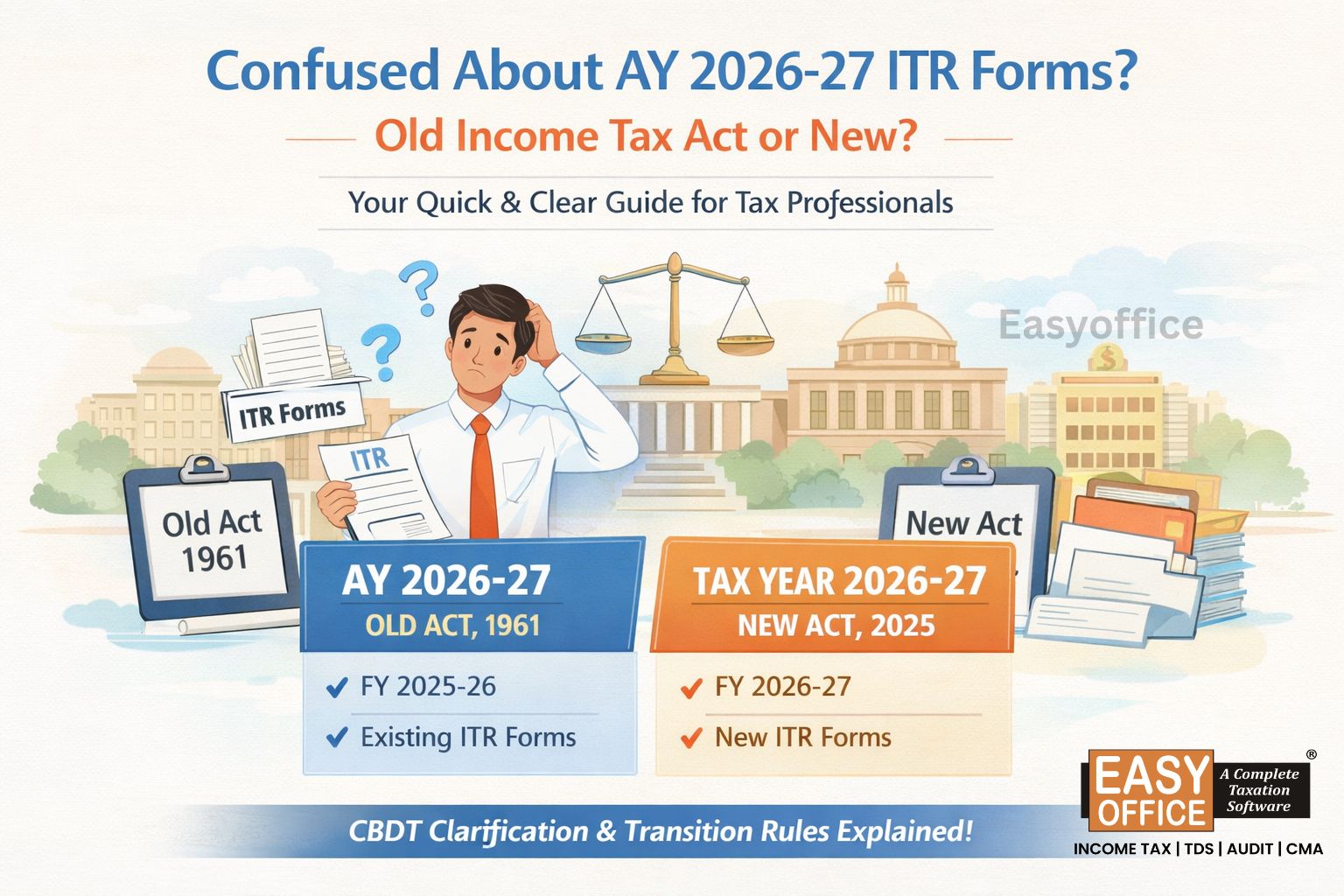
Important: Although the Income-tax Act, 2025 comes into effect from 1 April 2026, returns relating to AY 2026-27 continue to be governed by the Income-tax Act, 1961, including revision under Section 139(5).
What Is the Due Date for Revised Return of Income Tax?
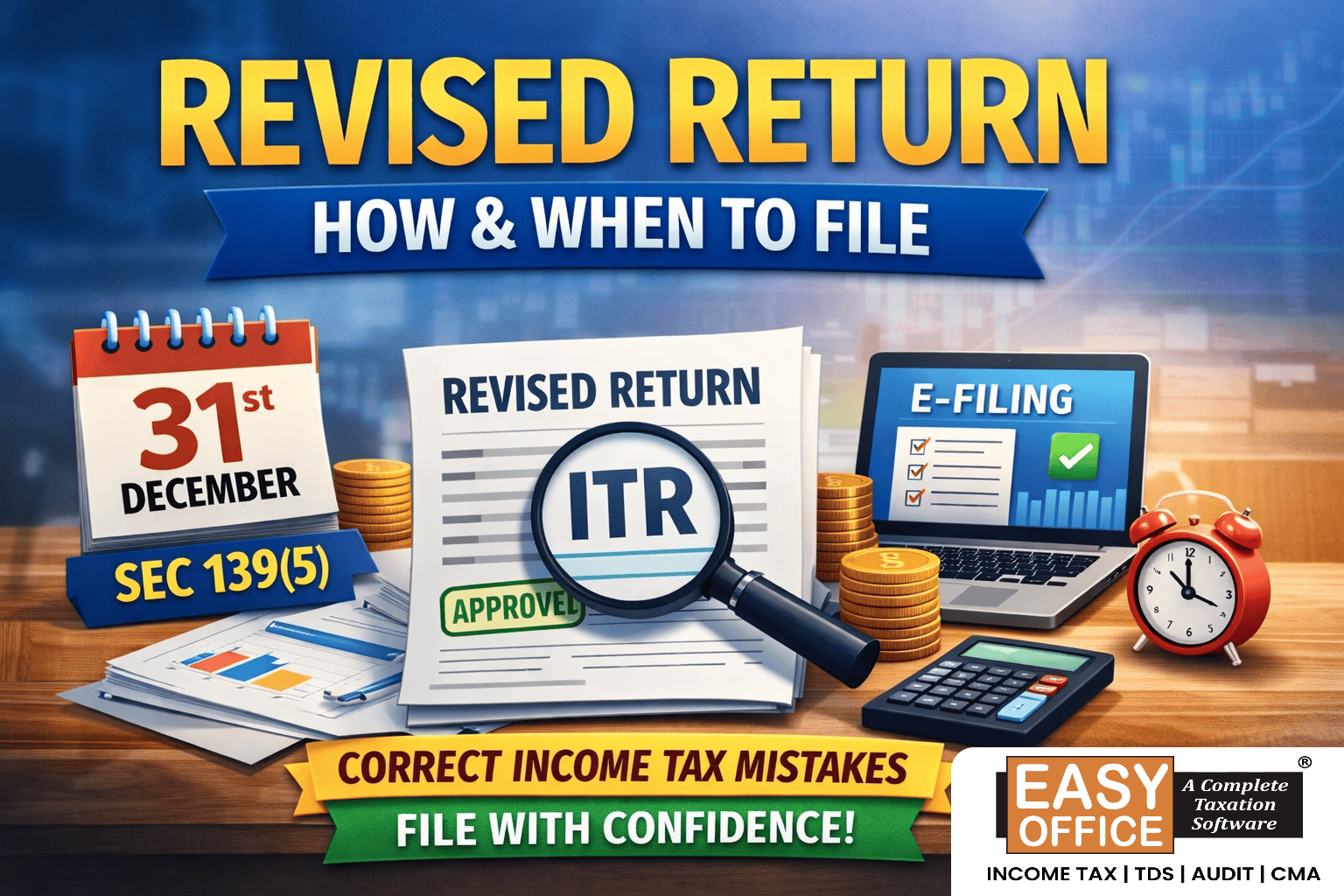
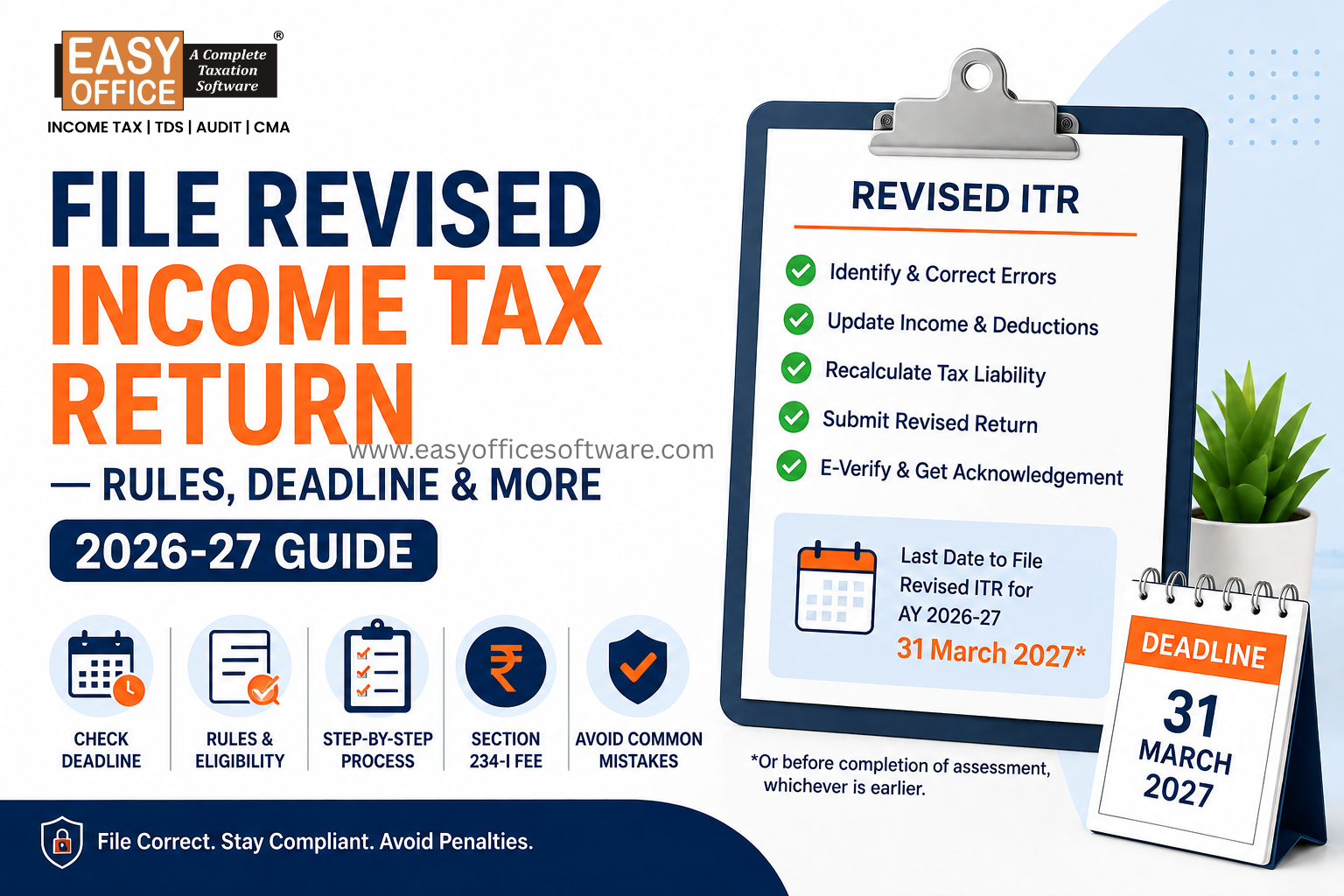
The deadline for filing a revised ITR for AY 2026-27 will be up to 31st March 2027 or before completing your assessment, whichever is earlier. This is different from the earlier revision timeline, which generally ended three months before the end of the relevant assessment year.
There's one catch, though. A revised return filed after 31 December 2026 and before 31 March 2027 attracts an additional fee under Section 234-I of ₹1,000 if your total income is up to ₹5 lakh and ₹5,000 if it's higher.
Quick deadline guide
| Period | What it means |
| Up to 31 December 2026 | Revised return generally permitted without Section 234-I additional fee |
| 1 January – 31 March 2027 | Still permitted, subject to Section 234-I additional fee |
| After 31 March 2027 | The regular revision window is generally closed |
Keep in mind that if your assessment wraps up before March 2027, that closes your window too, regardless of how much time is technically left.
How to File Revised Return for AY 2026-27
Revising your ITR isn't very different from filing it the first time. You'll just need a few extra details from your original filing.
Step 1: Go through your original ITR carefully
Before touching anything, figure out exactly what went wrong. Match your filed return against your Form 16, AIS, Form 26AS, bank statements, any investment proofs and Original ITR acknowledgement and computation.
Step 2: Log in to the e-Filing website
Go to the official Income Tax e-Filing website and log in using your PAN number and other login details.
Step 3: Select AY 2026-27
Select Assessment Year 2026-27 along with the same ITR form that you chose before, unless there was any mistake while choosing the ITR form.
Step 4: Select Revised Return Under Section 139(5)
Choose Revised Return as the type of filing under Section 139(5). Here you will need your original return’s acknowledgement number and filing date.
Step 5: Fix the actual errors
Update the income, deductions, TDS or tax payment details that need correcting. Don't casually edit fields you're unsure about; check your documents first.
Step 6: Recheck your tax liability
Once you've made the corrections, recalculate what you owe. If there's additional tax payable, clear it before you submit.
Step 7: Submit and e-verify
Complete e-verification right after submitting as an unverified return simply doesn't count, and your original filing stays as-is. Save your new acknowledgement for your records.
Good income tax software genuinely earns its keep at this stage. It can flag mismatches with your AIS, auto-pull your earlier data and reduce the chance you'll repeat the same mistake.
How Many Times Can a Revised Return Be Filed?
A question many taxpayers ask: how many times can a revised return be filed?
There's no fixed numerical cap under Section 139(5). In practice, you can file a revised return more than once, as long as you're still within the permitted time frame.
Say you file your ITR in July 2026, spot an error in September and revise it. Then in November, you notice something else you missed. You're generally allowed to revise it again, provided the deadline hasn't passed.
That said, don't treat repeated revisions as a substitute for careful review. Each time you revise, go through the entire return again, not just the one field you remembered was wrong.
Common Mistakes to Avoid
A revised return is easy to get wrong if you rush it. Watch out for these:
1. Skipping AIS and Form 26AS. Always reconcile your income and TDS entries before submitting.
2. Filing under the wrong assessment year. AY 2026-27 covers income earned in FY 2025-26; mixing this up is more common than it sounds.
3. Losing track of the original acknowledgement number. You can't file a revision without it.
4. Waiting until the last week. Portal traffic tends to spike close to deadlines and technical glitches aren't rare.
5. Fixing only the error you spotted. Since the revised return replaces the whole original, review it end to end.
6. Confusing this with ITR-U. An updated return follows a different set of rules and tax implications altogether.
Revised ITR vs ITR-U: What's the Difference?
| Revised ITR | Updated ITR (ITR-U) |
| Section 139(5) | Section 139(8A) |
| Corrects omission/wrong statement | Used to update income/return subject to specific conditions |
| AY 2026-27 revision generally up to 31 March 2027 | Has a different extended time window |
| Section 234-I fee can apply after 31 Dec 2026 | Additional tax applies under applicable ITR-U provisions |
| Can generally be revised multiple times within permitted period | Updated return can be filed once for a AY |
FAQs About Revised ITR and Income Tax Software
1. Can I revise my ITR after already filing it?
Yes. If you discover an omission or wrong statement in an ITR already filed under the applicable provisions, you may be able to correct it by filing a revised return under Section 139(5) within the prescribed time.
2. Till what date can a revised income tax return for Assessment Year 2026-27 be filed?
March 31, 2027, or before the completion of your assessment, whichever is earlier. An additional fee under Section 234-I applies to revised returns filed after 31 December 2026.
3. What is the Section 234-I fee for revised ITR AY 2026-27?
For AY 2026-27, Section 234-I charges an additional fee on a revised ITR filed after 31 December 2026. The fee is ₹1,000 for total income up to ₹5 lakh and ₹5,000 for total income above ₹5 lakh.
3. How many times can a revised return be filed?
There's no set limit under Section 139(5). You can file multiple revisions as long as you stay within the deadline.
4. Can I update my bank account or income details in a revised return?
Yes, both can generally be corrected through a revised return, provided the statutory conditions are met.
5. Is income tax software actually useful for this?
Yes. It helps organise your financial data, catches calculation slip-ups, and simplifies the return before you submit, though you should still cross-check the final numbers against your official documents.
Conclusion
A revised ITR provides taxpayers an opportunity to correct eligible omissions or errors in a return that has already been filed. In case of AY 2026-27, make sure to remember the deadline of 31 March 2027, as well as the extra charge that will apply if you revise after 31 December 2026.
The best thing that one can do is to verify his or her AIS, Form 26AS, Form 16, and deduction certificates before re-filing the ITR. And if you'd like a more organised way to handle the calculations, EasyOfficeSoftware's Income tax software can make the whole process a lot less stressful.
Revised Income Tax Return, Revised ITR, ITR Filing
Related Blogs



All in one Software
- Income Tax Software
- TDS & TCS Software
- Audit e-filing Software
- CMA Data Software









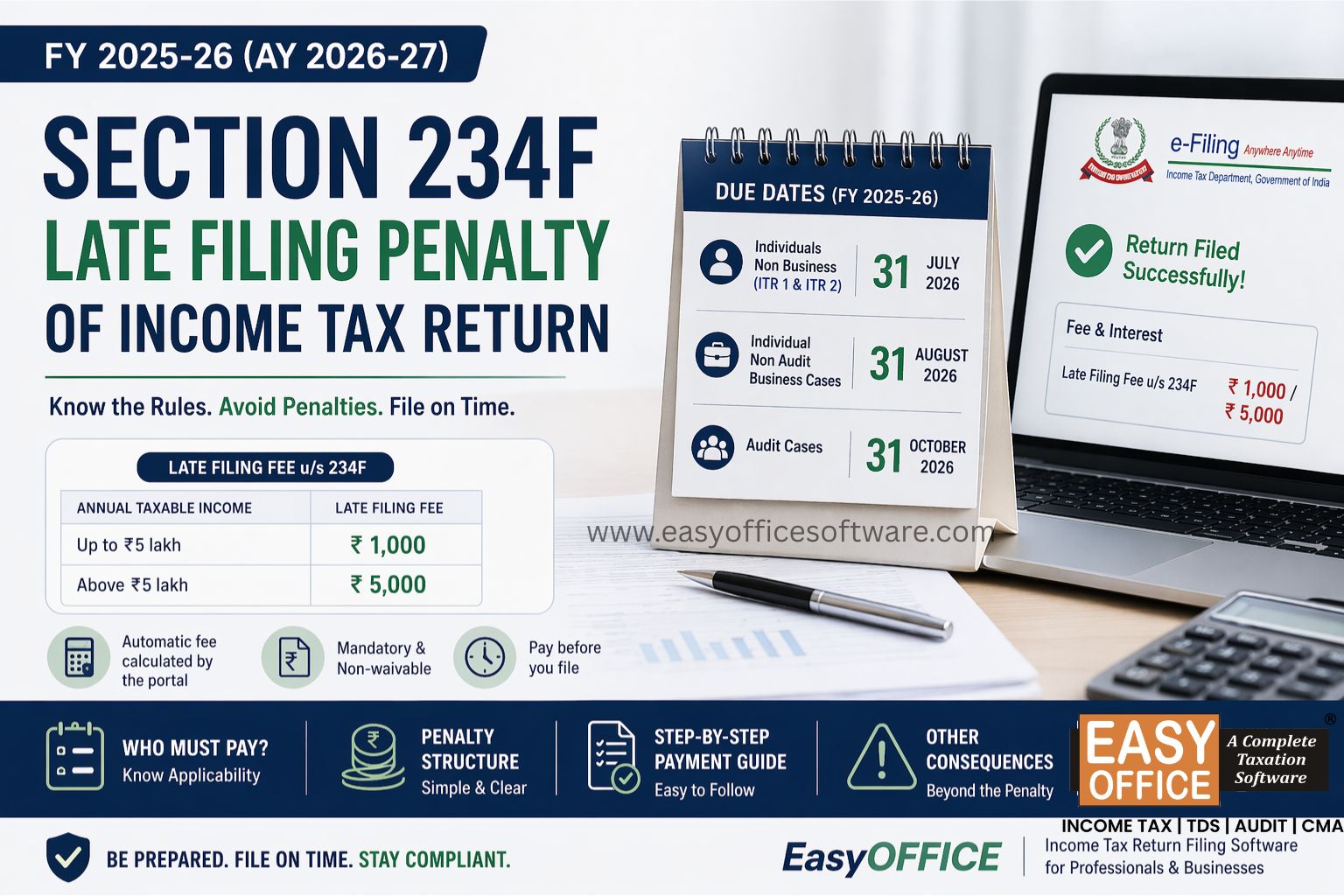
Penalty for Late Filing of Income Tax Return for FY 2025-26 – Section 234F of Income Tax Act 1961
#ITR