When you miss your TDS deposit deadline, it might feel like a small mistake. But the Indian Tax System responds to it systematically. Here is what happens when you miss a TDS deposit deadline and what to do to limit the damage.
What is TDS?
Tax Deducted at Source (TDS) is the amount that is deducted from salary, interest, rent or professional fees. The payer can be an employer, a company or an individual who deducts the tax at the point of payment and deposits it to the government. The deductor holds the money in trust, and if that trust is broken, penalties follow.
The 3-layer consequences
When you miss a TDS deadline, it does not result in a single fine. Rather, it has consequences in 3 different areas.
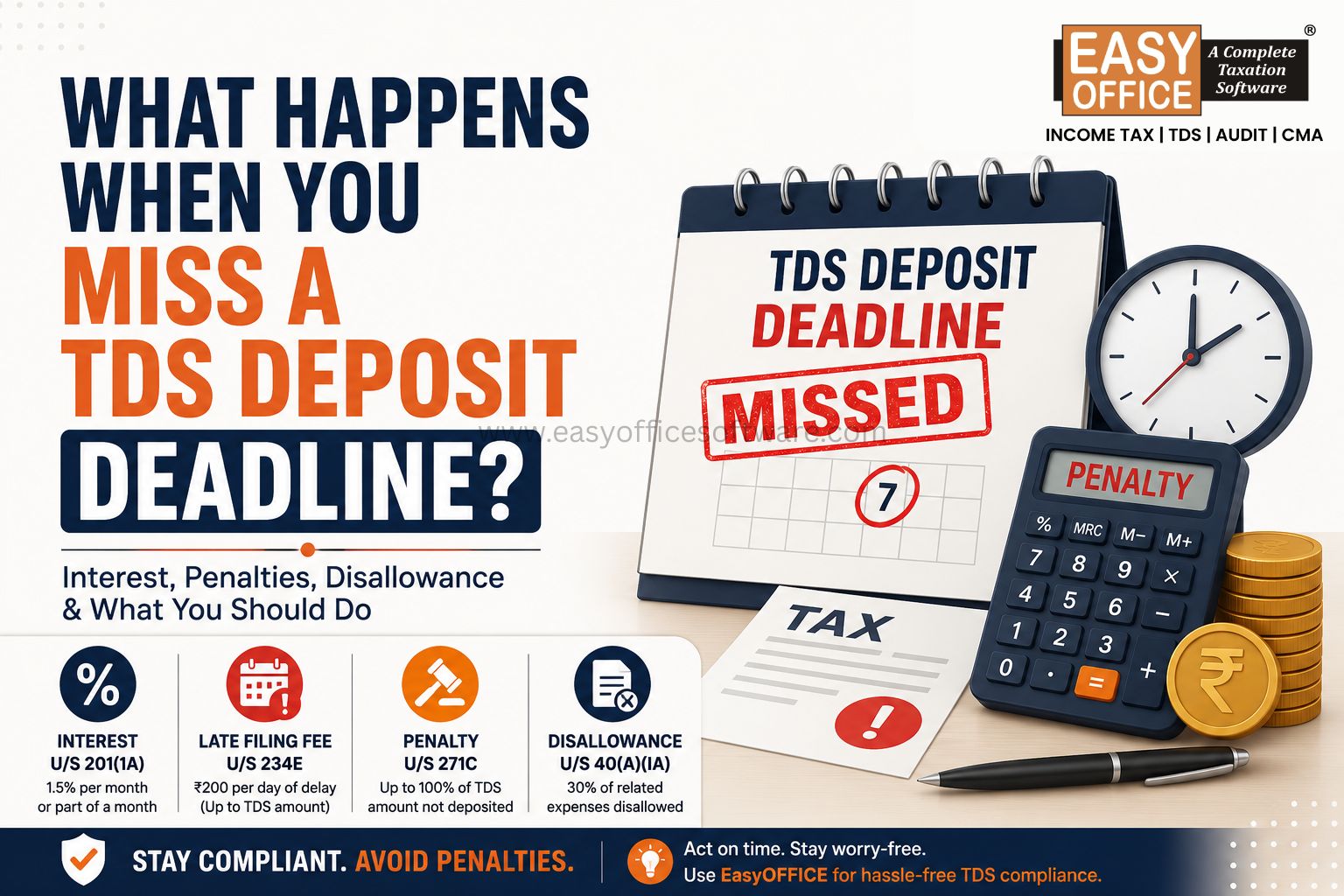
| Interest u/s 201(1A) | Late Filing Fee u/s 234E | Penalty u/s 271C |
| 1.5 % per month (or part of a month) from the date of deduction to the date of actual deposit | Rs. 200 per day of delay for TDS return, up to the total TDS amount | Up to 100 % of the TDS amount not deposited. It is discretionary and levied by the Joint Commissioner |
Interest Charges u/s 201 (1A)
I. Interest is charged at
a. 1% per month (or part of a month) in case of failure to deduct TDS
b. 1.5 % per month in case of failure to deposit TDS after deduction
II. Interest is charged from the date the tax was deductible or deducted and not from the due date.
III. A single-day delay is counted as a full month. So, prolonged delays greatly compound the liability.
Example: If TDS of ₹50,000 deducted on 20 March is deposited on 9 April, interest is charged for two months, not 20 days.
Late Filing Fee u/s 234E
The late filing fee is separate from interest. In case the TDS return is filed late, regardless of when the payment was deposited, a fee of Rs. 200 per day is charged. However, this fee cannot exceed the TDS liability for that period.
| Scenario | Consequence | Risk Level |
| TDS deposited late, return filed on time | Interest @ 1.5%/month u/s 201(1A) | Moderate |
| TDS deposited on time, return filed late | Fee of ₹200/day u/s 234E | Moderate |
| Both deposit and return delayed | Interest + late filing fee + possible u/s 271C penalty | High |
| TDS not deducted at all | Disallowance of expense (u/s 40a(ia)) + interest + section 271C | Critical |
| Paid with minor delay, return filed promptly | Interest only, usually resolvable | Low |
The hidden cost of expense disallowance
This disallowance u/s 40(a)(ia) is often overlooked by many deductors. If the TDS is not deducted or deposited on time, 30% of your related expenses is disallowed for income tax purposes. This raises your income substantially for the year in which the payment was made.
One exception: If TDS is deducted in the current year but deposited before the filing of the return (by the due date), the disallowance under section 40(a)(ia) is reversed in the year of TDS Deposited. Timing matters enormously here.
✔ The disallowed portion becomes allowable in the year in which TDS is finally deposited.
Prosecution in extreme cases
When TDS is deducted but not deposited with the government, it is a misappropriation of the government’s funds. And provides for Prosecution u/s 276B. Punishment ranges from 3 months to 7 years of imprisonment along with a fine.
However, Prosecution is generally invoked only in cases of wilful and repeated default.
What to do when you miss the deadline
1. Immediately deposit the TDS - The sooner you deposit, the less interest you will be charged. Each month (or fraction thereof) will be charged 1.5%.
2. Compute and pay interest using Challan 281 - Interest u/s 201 (1A) must be deposited with the late deposit. Create the right challan using the Income Tax Portal.
3. Submit the TDS return as soon as possible - 234E charges are collected daily. Although payment is pending, you should file a return to halt the fee clock wherever possible.
4. Check for 40(a)(ia) impact- Determine whether your late deposit will impact expense deductibility in the current year or the prior year’s return.
5. Refer to a CA in cases of habitual defaults- In case it is a recurring problem, a chartered accountant will be able to help you reorganize your payment schedule and determine the risk of prosecution.
Tips to prevent delays
The best solution is to act in a structured way. A few systems can help prevent this problem entirely.
✔ Set reminders in your calendar on the 4th and 5th of every month to compute TDS.
✔ Maintain a dedicated bank account to transfer TDS immediately after deduction.
✔ Automate payment if your bank allows scheduled NEFT transfers to Challan 281.
✔ Every quarter, reconcile your 26AS against your own TDS data to detect mismatches quickly.
✔ Use accounting or TDS software to auto-calculate monthly liability and generate challans.
Conclusion
A missed TDS compliance in India results in several chained consequences with financial costs that compound quickly. Act fast, deposit with interest and create a system to prevent delays. The government notices patterns and deductors who correct themselves promptly are treated differently from those who don't.
FAQs
Q. What is the due date for depositing TDS each month?
A. TDS deducted in any month must be deposited by the 7th of the following month. The only exception is March, when TDS deducted in March can be deposited up to 30th April.
Q. What happens if I deducted TDS but never deposited it at all?
A. Deducting TDS and not depositing it is treated as misappropriating government funds. Section 276B provides for prosecution with imprisonment ranging from 3 months to 7 years, plus a fine.
Q. How do I pay the interest along with the late TDS deposit?
A. Use Challan 281 on the Income Tax portal or your bank's tax payment gateway. While depositing the TDS amount, include the interest calculated at 1.5% per month under Section 201(1A).
Q. Does a one-day delay really count as a full month of interest?
A. Yes. The law treats any part of a month as a full month for interest calculation. If you deducted TDS on March 20 and deposited it on April 9 (just 2 days late), interest is charged for two full months, March and April, not just 20 days.
Q. How can TDS Software help avoid TDS delays and penalties?
A. Using dedicated TDS compliance software like EasyOFFICE helps deductors stay compliant by automating monthly TDS calculations, challan preparation, due-date tracking, and return filing.
It reduces manual errors, sends timely reminders and helps businesses and professionals avoid interest, late fees and penalties arising from missed deadlines.
Related Blogs


All in one Software
- Income Tax Software
- TDS & TCS Software
- Audit e-filing Software
- CMA Data Software




















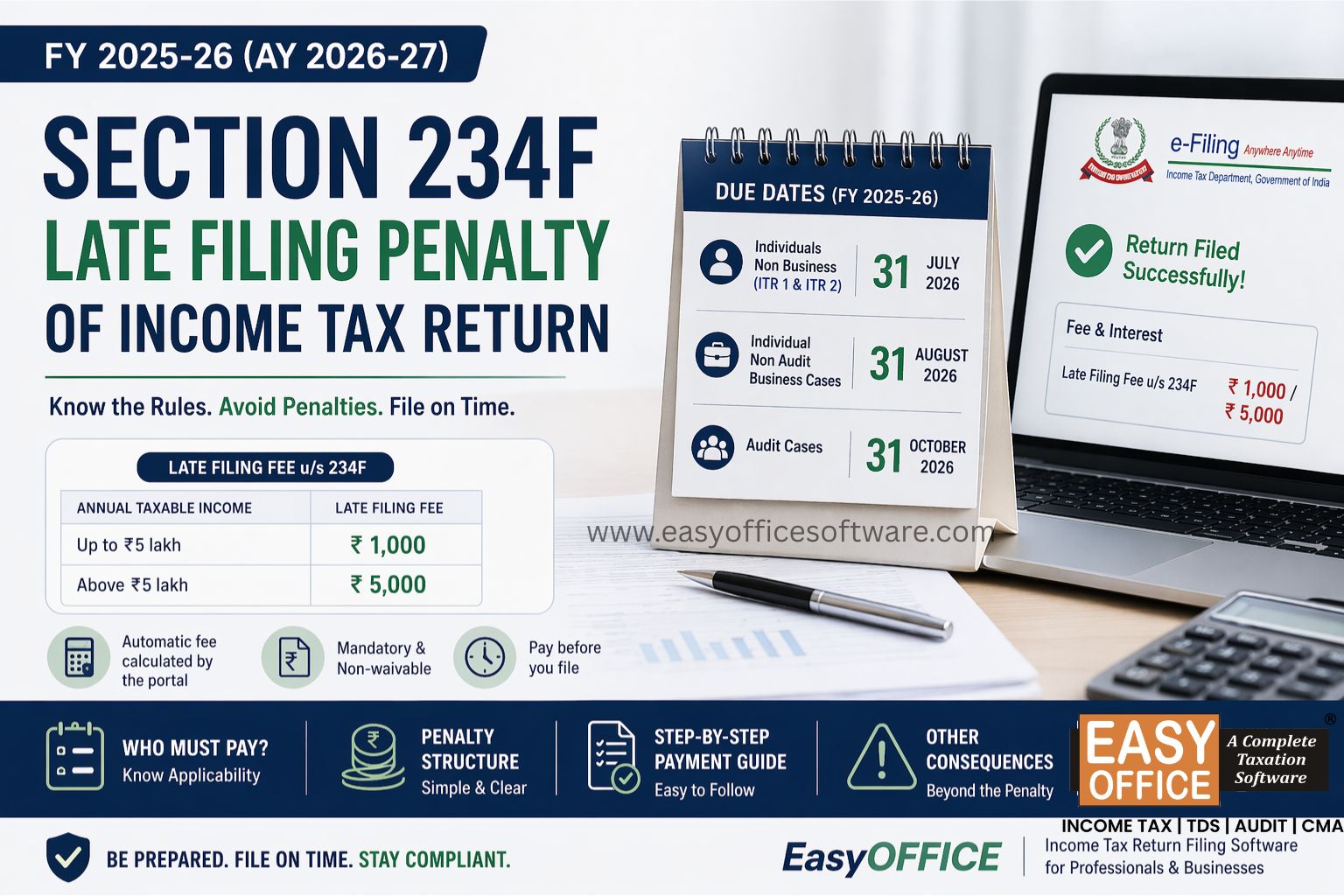
Penalty for Late Filing of Income Tax Return for FY 2025-26 – Section 234F of Income Tax Act 1961
#ITR