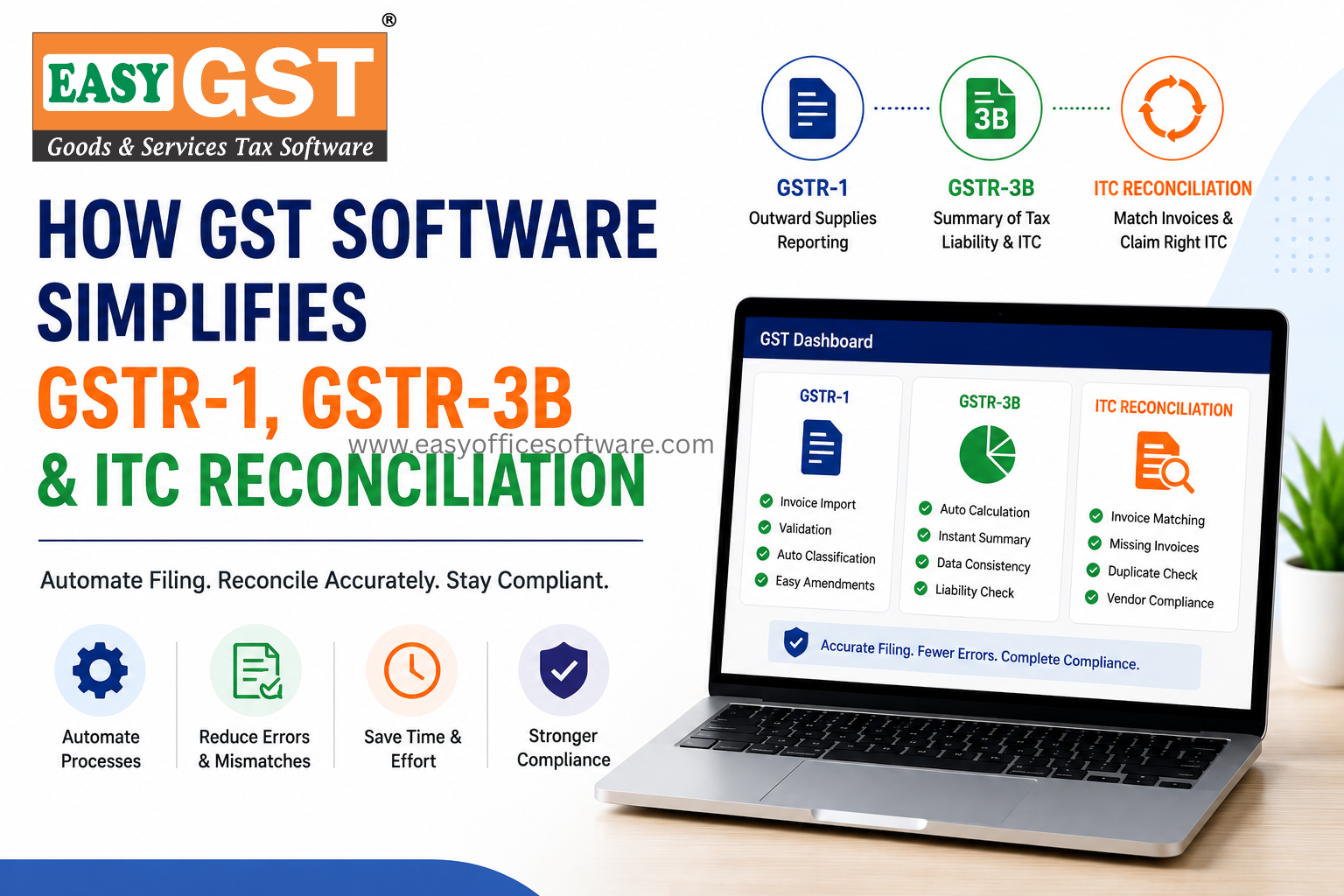
Any business that is registered for GST in India needs to file its GST returns on a regular basis as per their prescribed return frequency. This is one process that is vital for maintaining compliance and preventing fines. Most companies come across a number of issues like invoice matching, ITC matching and data consistency between GSTR-1 and GSTR-3B.
This is precisely the point where the best GST return filing software finds its rightful place. It takes over the repetitive, error-prone parts of GSTR-1, GSTR-3B and ITC matching, so your team isn't spending days in a month just double-checking numbers.
Let's break down how good GST software actually simplifies GSTR-1, 3B & ITC reconciliation.
Why Accurate GST Filing Matters
Here's the thing: people often miss GSTR-1, GSTR-3B and their ITC claims aren't separate boxes to tick. They're all connected and discrepancies between reported outward supplies, tax liability and ITC can lead to additional reconciliation, clarification or compliance requirements.
Some of the usual troublemakers:
i. Manual entry errors
ii. Missing invoices
iii. Duplicate entries
iv. Wrong GSTIN
v. Books vs portal mismatch
vi. ITC discrepancies
A decent GST tool catches most of these before you even hit submit, which honestly saves a lot of sleepless nights around the 20th of every month.
Understanding GSTR-1, GSTR-3B and ITC Reconciliation
What Is GSTR-1?
GSTR-1 is where you report details of outward supply made for the applicable tax period. That includes:
a) B2B sales
b) B2C sales
c) Credit notes
d) Debit notes
e) Export invoices
f) HSN/SAC details.
g) Amendments
GSTR-1A: GSTR-1A provides a facility for taxpayers to amend or add certain details for the relevant tax period before filing GSTR-3B, as per GST provisions.
This data doesn't just sit there; it's what your buyers use to claim their own input tax credit. So accuracy here isn't just about your compliance; it affects theirs too.
What Is GSTR-3B?
Think of GSTR-3B as simplified summary sheet for declaring GST liabilities and discharging those liabilities. It pulls together:
a) Taxable sales
b) Tax payable
c) ITC available
d) Net liability
e) Payment details
It looks simple on the surface, but these numbers need to line up closely with what you've already reported in GSTR-1. If they don't, that gap rarely goes unnoticed.
What Is ITC Reconciliation?
This is the process of comparing:
a) Your purchase records
b) Supplier-uploaded invoices
c) GSTR-2B
d) Accounting entries
ITC reconciliation generally involves comparing purchase records with supplier reported invoice data reflected in GSTR-2B and ITC reported in GSTR-3B.
The whole point is to make sure you're claiming credit you're actually entitled to and to catch missing invoices early enough to do something about them.
How the Best GST Return Filing Software Handles GSTR-1
1. Automatic Invoice Import
GST software gets its data automatically from the following sources:
a) Accounting software
b) ERP software
c) Excel spreadsheets
d) Billing software
It saves a lot of manual effort.
2. Invoice Validation Before Filing
The best GST software validates that the invoice does not have:
a) Wrong GSTIN number
b) Wrong HSN/SAC codes
c) Wrong tax calculation
d) Missing entries
e) Duplicate invoices
All these mistakes should be corrected before filing to reduce chances of GST notices.
3. Automatic Classification of Transactions
The software segregates invoices as follows:
a) B2B
b) B2C
c) Exports
d) SEZ supplies
e) Nil-rated supplies
f) Exempt supplies
Thus, preparing the GSTR-1 is done without sorting manually.
4. Easy Amendments
If any amendment needs to be done in an invoice after its filing, GST software will help in making the relevant amendments.
How GST Software Simplifies GSTR-3B Preparation
Preparing GSTR-3B by hand usually means pulling numbers from five different reports and hoping they all agree. Software takes that guesswork out entirely.
1.Auto tax calculation
CGST, SGST, IGST, and CESS get calculated straight from invoice-level data, not from someone's spreadsheet formula that may or may not still be correct.
2. Instant summaries
You get instant visibility into total turnover, tax collected, ITC available, tax payable and any pending liability all in one screen.
3. Data consistency
Since GSTR-3B is built from the same validated data as GSTR-1, the odds of a mismatch between the two drop considerably. Software also provide reconciliation Between GSTR-1 and GSTR-3B.
How GST Software Automates ITC Reconciliation
This is honestly where the software earns its cost.
1.Matching purchase invoices
It compares your purchase register against supplier invoices and portal data and flags gaps almost instantly instead of you finding out weeks later.
2. Spotting missing invoices
Suppliers forget to upload; sometimes it happens more often than you'd think. Good software identifies missing invoices, pending uploads and partial matches, so you can follow up before the filing window closes.
3. Catching duplicate claims
Duplicate ITC entries are a classic trigger for scrutiny, and the software flags them before they become your problem.
4. Tracking vendor compliance
Some tools go a step further and monitor which suppliers consistently file late. That's useful information when you're deciding who to keep relying on.
Real Benefits of Automated GST Reconciliation
Saves real time
Fewer manual errors
Stronger compliance
Faster ITC reconciliation
Improved compliance tracking
Common Mistakes Businesses Should Avoid
a) Ignoring reconciliation reports — always review mismatches before filing, not after the fact.
b) Invoice uploading delayed – late invoices cause major reconciliation problems.
c) GSTIN not updated – Outdated information leads to unnecessary rejection of invoices.
d) Making incorrect ITC claims blindly – software can help a lot, but exceptions require human judgement.
e) Waiting until the deadline – starting early allows you to fix any problems with suppliers rather than just notice them.
f) Not reconciling GSTR-1, GSTR-3B and GSTR-2B
g) Ignoring GSTR-1A where applicable
Tips for Choosing the Right Software
Check for:
a) Automatic tax return preparation
b)ITC reconciliation
c) Mass invoice upload
d) ERP integration
e) Detection of errors
f) Compatibility with GST portal
g) Cloud storage
h) Compliance updates
i) Simple Dashboard
j) GSTR-1/1A preparation
k) GSTR-3B preparation
l) GSTR-2B reconciliation
m) Books vs GST portal reconciliation
FAQ
1. What GST filing software should be used by an Indian company?
The one that would automate GSTR-1, GSTR-3B and ITC matching process, verify your invoices correctly, and integrate perfectly with your accounting system.
2. What is the importance of ITC reconciliation?
It make sure that you do not claim any undue credit and prevents the problem of late submission of invoices from suppliers.
3. Can GST software actually reduce filing errors?
Yes, it validates GSTINs, checks tax calculations, and catches duplicate or missing entries before you ever hit submit.
4. Is it worth it for small businesses too?
Definitely. Even small businesses save real time and cut down compliance risk without needing to hire extra hands.
5. What is the difference between Form GSTR-1 and GSTR-3B?
GSTR-1 primarily reports details of outward supplies, while GSTR-3B is a summary return used to declare GST liabilities and eligible ITC and discharge tax liability (Payment Return).
6. Can GST software reconcile GSTR-2B with purchase records?
Yes. GST reconciliation software reconciles purchase data with GSTR-2B and classify transactions into matched, mismatched, missed by us, Missed by vendor or other categories, depending on the features of the software.
7. Can GST software prepare both GSTR-1 and GSTR-3B?
Yes. Major GST software solutions can prepare both returns, helping businesses maintain consistency between outward supplies and summary tax liability.
8. What is GSTR-1A and how is it related to GSTR-3B?
GSTR-1A provides an additional facility for making specified amendments or additions to GSTR-1 data for the relevant tax period. Information from GSTR-1/1A is used in the system-generated GSTR-3B as per the provisions.
Conclusion
As a business grows, manually reconciling invoices and matching ITC gets harder to sustain; there's just too much room for something to slip through. The best GST return filing software takes that pressure off through automation, real-time checks, and cleaner data across every return you file.
If you're ready to make GST compliance less of a headache, EasyOfficeSoftware's EasyGST solutions are built to handle exactly this, so your team can spend less time reconciling numbers and more time actually growing the business.
GST Software, GSTR-1, GSTR-3B, ITC Reconciliation
Related Blogs



All in one Software
- Income Tax Software
- TDS & TCS Software
- Audit e-filing Software
- CMA Data Software








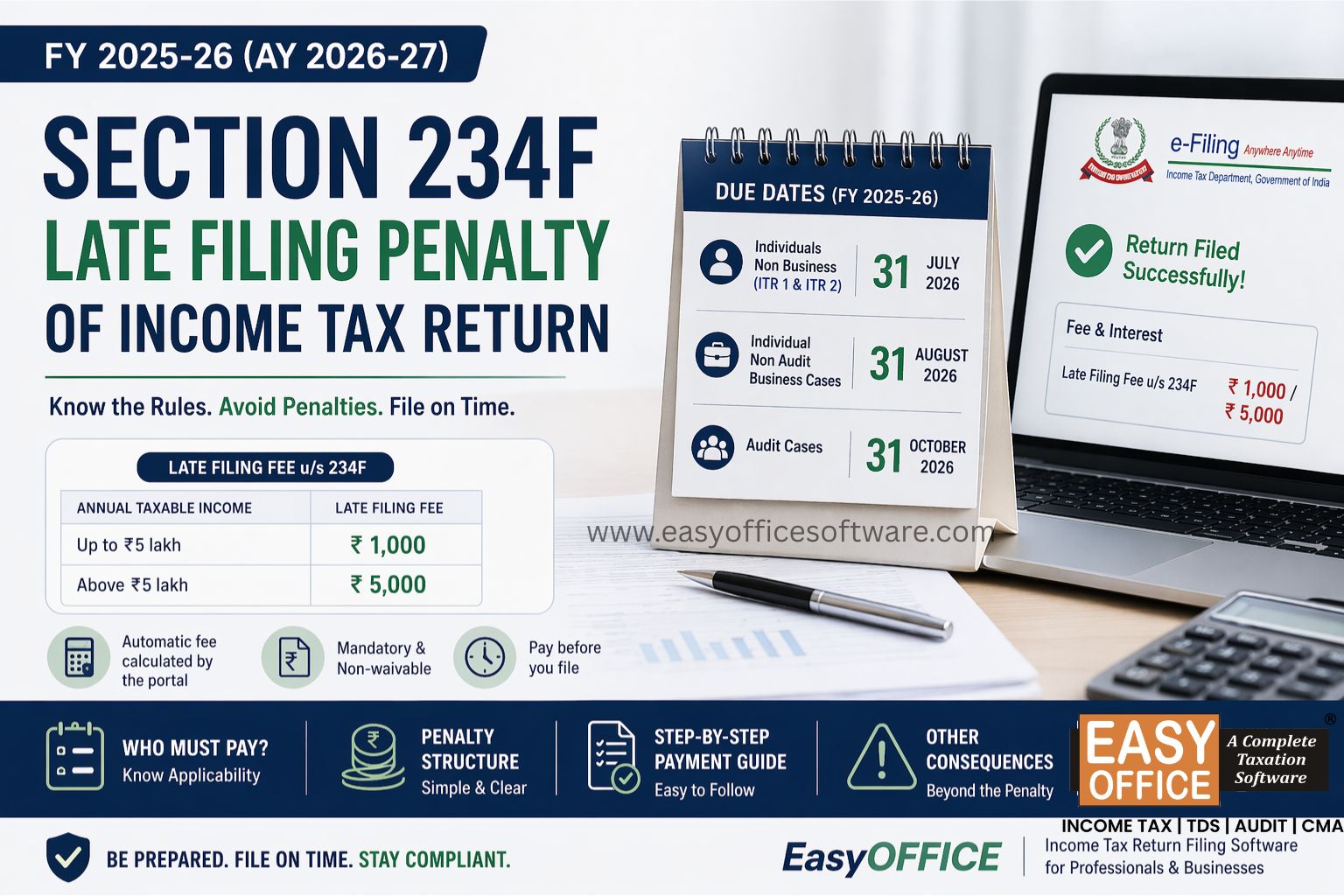
Penalty for Late Filing of Income Tax Return for FY 2025-26 – Section 234F of Income Tax Act 1961
#ITR