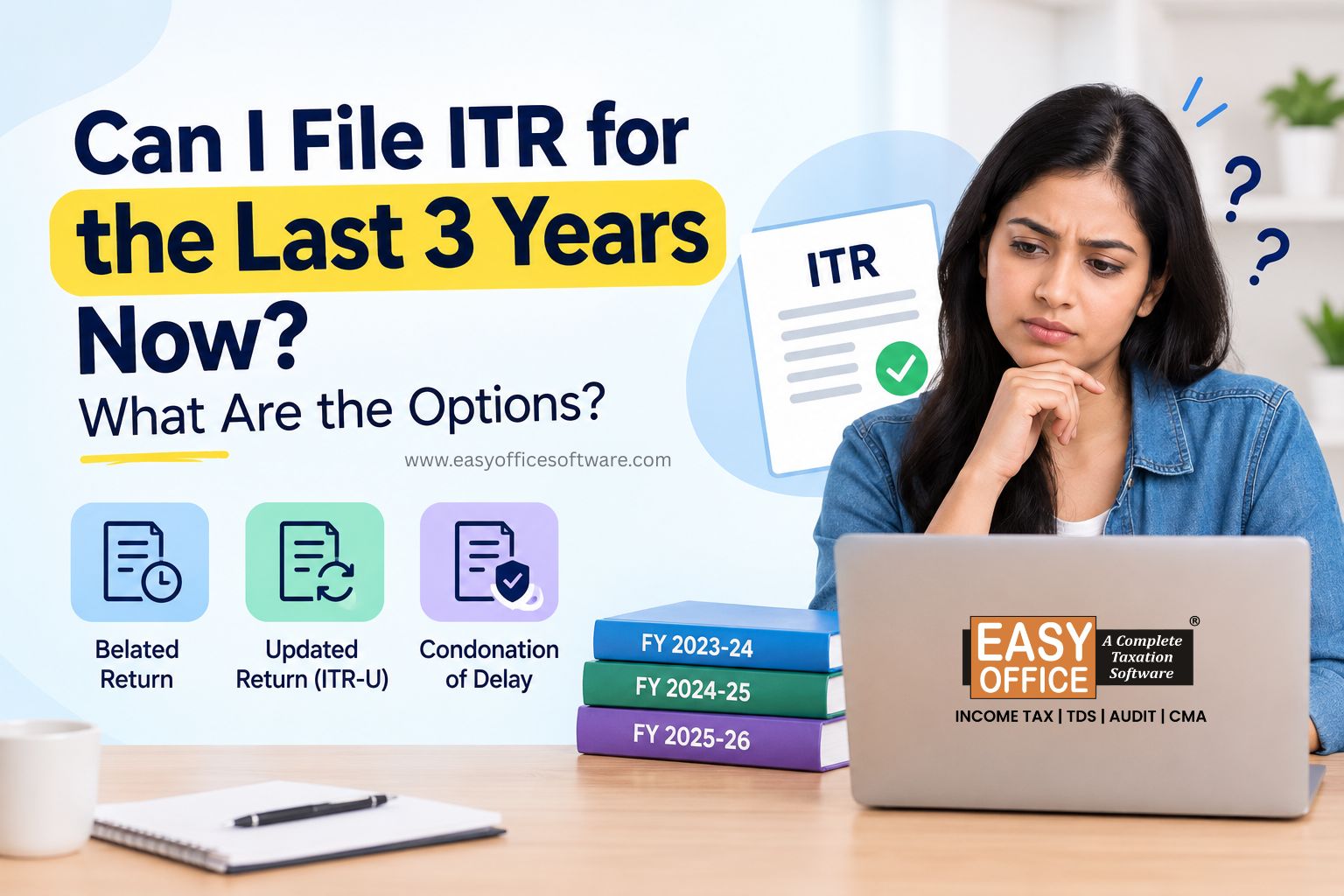
Missed your ITR in the past three years? You may still have options, but the right approach depends on the assessment year, the applicable deadlines and your circumstances.
But there is one problem: you cannot submit your returns for the last three years online whenever you feel like doing so. It depends on the year of assessment, whether the belated due date has expired, and whether you owe any tax or have a tax refund.
Whether you're salaried, a freelancer, or a small business owner, it happens more often than you might think.
This guide walks you through your real options, plus how professional ITR filing software can take a lot of the stress out of catching up.
Can I File ITR for the Last 4 Years Now?
Yes, in most cases, but it depends entirely on the assessment year involved.
For recent years, a regular belated return might still work. For older years, an updated return (ITR-U) is usually your path forward.
For example, the belated-return deadline for AY 2026–27 is 31 December 2026, or before completion of assessment, whichever is earlier. This deadline does not apply automatically to older assessment years.
Financial Year vs Assessment Year (Don't Mix These Up)
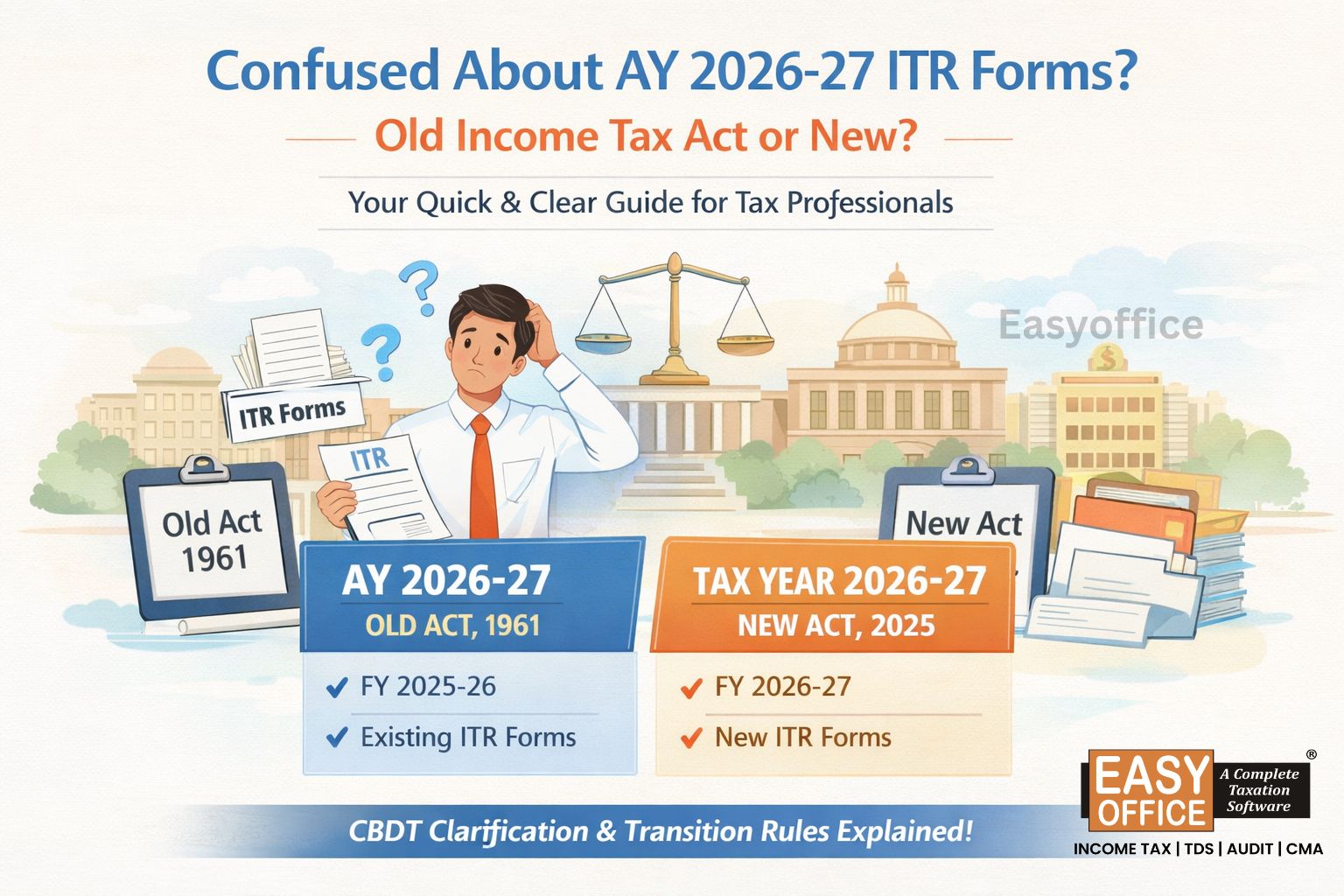
It is in this step that most individuals tend to get confused. The Financial Year (FY) is year in which you earn the respective income. The Assessment Year (AY) is the year in which that income is reported and assessed for tax purposes.
FY 2025-26 → AY 2026-27
FY 2024-25 → AY 2025-26
FY 2023-24 → AY 2024-25
FY 2022-23 → AY 2023-24
The income that an individual makes from April 2025 to March 2026 falls under the Assessment Year 2026-27
.
What Are Your Options for Filing Old ITRs?
You've basically got three routes, depending on your situation.
1. Submitting the Belated Return
‘Belated Return’ refers to the income tax return submitted after the original due date but within the permitted belated-return period.
The deadline for filing a belated return for the financial year 2025-26 shall be till 31st December 2026.
This works when:
- Missed the original deadline
- Belated window still open
- Want to report income properly
But if that window has already shut for an older year, this route won't help you anymore. Applicable late-filing fees and interest depend on your circumstances.
2. File an Updated Return (ITR-U)
This is the one most people actually need.
Under Section 139(8A), an eligible taxpayer can file an updated return within 48 months from the end of the relevant assessment year. This applies even if you never filed an original return at all.
Say you earned income in FY 2022-23 but never got around to filing. Check if AY 2023-24 still falls within that 48-month window, and if it does, ITR-U lets you report that income now, along with the extra tax due.
Good to know:
- No refund allowed
- Cannot reduce liability
- Additional tax applies
- Only one updated return is permitted for an assessment year.
3. Condonation of Delay Request
Reserved for special cases, mostly genuine cases, under Section 119(2)(b).
This isn't automatic. Every application is reviewed separately; therefore, you should consult with a tax professional before applying for this process.
This route may be relevant to eligible delayed refund claims or certain claims involving the carry-forward of losses. The request must satisfy the applicable conditions and is subject to approval by the competent income-tax authority.
How Many Years Back Can ITR-U Actually Go?
The 48-month rule applies uniformly:
| Assessment Year | Income From | General ITR-U deadline |
| AY 2025-26 | FY 2024-25 | 31 March 2030 |
| AY 2024-25 | FY 2023-24 | 31 March 2029 |
| AY 2023-24 | FY 2022-23 | 31 March 2028 |
| AY 2022-23 | FY 2021-22 | 31 March 2027 |
Don't assume every pending year automatically qualifies. Always check eligibility first.
What Does ITR-U Actually Cost You?
The longer you wait, the more it costs.
| Time of filing the updated return | General additional-tax rate |
| Within 12 months | 25% |
| After 12 months and within 24 months | 50% |
| After 24 months and within 36 months | 60% |
| After 36 months and within 48 months | 70% |
These percentages apply to the relevant aggregate of tax and interest as prescribed by law, rather than directly to your total income.
Do I Still Need to File If I Owe No Tax?
Filing and owing tax are two separate things.
If your income stayed below the taxable limit, you might not have any tax due. But whether you can still file for that year depends purely on eligibility, not on how much you owe.
Check this before assuming ITR-U isn't relevant to you. If there's genuinely no additional tax payable, ITR-U might not even be the right fit as additional income is required to be reported, and a tax expert can point you toward the correct remedy.
Filing Old ITRs With ITR Filing Software
Getting organised first makes everything smoother.
Step 1: List missing assessment years
Note down every unfiled AY clearly.
Step 2: Gather documents
PAN and Aadhaar
Form 16
Bank statements
Form 26AS and AIS
Investment proofs
Step 3: Pick the right AY
Match income to the correct assessment year, not the calendar year.
Step 4: Confirm your filing route
Belated, ITR-U, or condonation.
Step 5: Calculate and pay
Use ITR filing software to cross-check tax and interest before submitting.
Step 6: Submit and verify
Complete the return by successfully filing it on ITD Portal. Verify it within the prescribed period and save the acknowledgement and payment challans for future reference.
Income tax filing software can help organise information, calculate tax and review return details. Before using it for a pending year, confirm that it supports the relevant assessment year and return type
Common Mistakes to Avoid
1. Confusing FY with AY
2. Assuming ITR-U fits every year
3. Ignoring interest charges
4. Forgetting rental or FD income
5. Skipping AIS comparison
6. Filing at the last minute
FAQs
1. Can I file ITR for the last 4 years now?
Yes, the available option depends on the assessment year and your circumstances. A belated return may be available if the deadline remains open. For older years, ITR-U or a condonation request may be relevant if you qualify.
2. Can I file all 4 years of ITR together?
No, because each assessment year requires its own return, even though you may be preparing them all at once
3. Can I file ITR-U without an original return?
Yes. An eligible taxpayer can generally file an updated return even if an original return was not filed for that assessment year, subject to conditions.
4. Can I get a refund via ITR-U?
No, updated returns can't be used to claim or increase a refund.
5. Is ITR filing software useful for old returns?
Definitely. It helps organise records, calculate additional tax accurately and avoid year-selection errors.
6. What if I have no additional tax to pay?
ITR-U may not be suitable if no additional tax is payable. Your available options depend on the reason for the missed return and your specific circumstances.
7. What should I do if I missed the ITR deadline for more than three years?
Identify each assessment year and check its applicable filing options separately. Depending on the circumstances, ITR-U or a condonation request may be relevant. Consult a tax professional if the case involves a refund, business income or a notice from the department.
Final Thoughts
If your ITR is missing for three years, it does not mean that you can neglect your tax documents. You might have alternatives, but what is right to follow will depend upon several factors. Begin with the identification of the Assessment Years and their respective deadline dates, and obtain Form 16, AIS, Form 26AS, and bank statements. In case of a refund claim and complicated business income, seek tax assistance.
Once you're ready, reliable ITR filing software turns this whole process into something manageable instead of stressful.
Ready to get your pending ITRs sorted? Visit us and see how much simpler filing old returns can be.
ITR Filing, Updated ITR, Income Tax Return, ITR Filing
Related Blogs


All in one Software
- Income Tax Software
- TDS & TCS Software
- Audit e-filing Software
- CMA Data Software







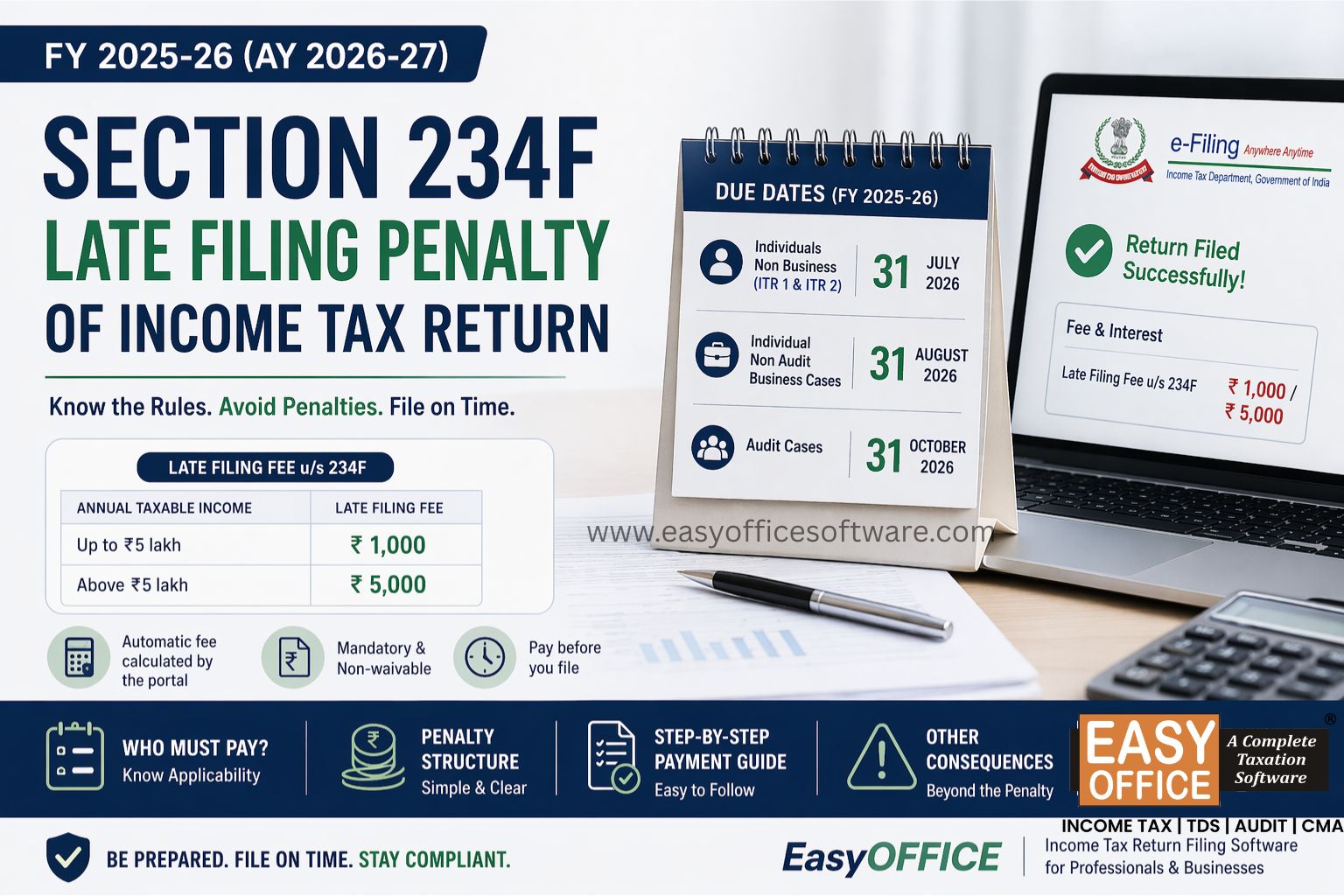
Penalty for Late Filing of Income Tax Return for FY 2025-26 – Section 234F of Income Tax Act 1961
#ITR