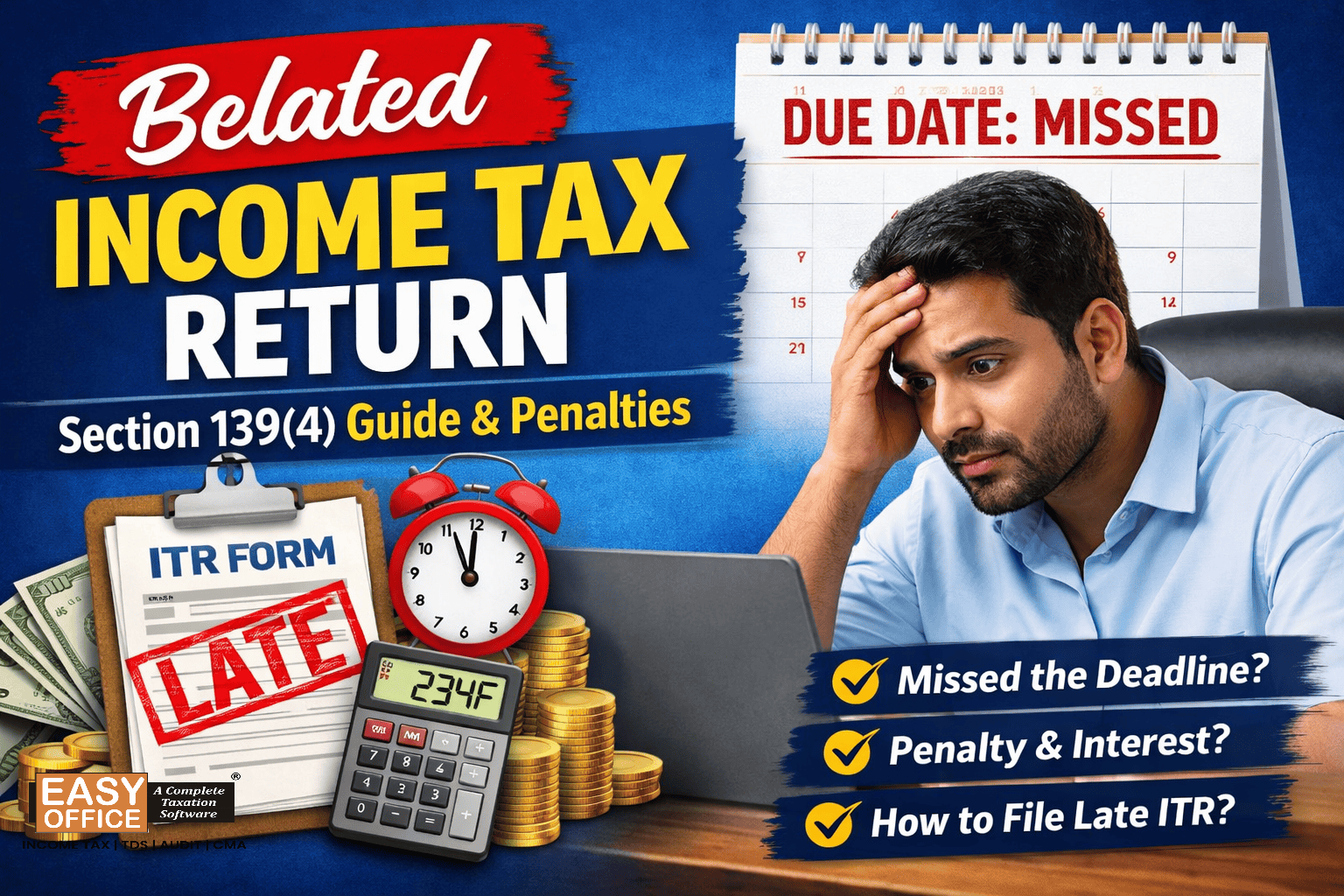
Missed the income tax return (ITR) due date? You’re not alone. Every year, lakhs of Indian taxpayers—salaried individuals, freelancers, and small business owners—miss the deadline due to workload, confusion, or lack of documents.
The good news is that the Income Tax Act gives you a second chance through a belated return under Section 139(4). Filing late does come with a cost, but it is always better than not filing at all. Let’s understand how belated returns work, what penalties apply, and how income tax return filing software can make late filing stress-free.
Missed the ITR Due Date? Don’t Panic
According to Income Tax Department data, over 7 crore ITRs are filed every year, and nearly 10–15% are belated returns. Many taxpayers wrongly assume that missing the due date means they cannot file at all. That’s a costly mistake.
Filing a belated return helps you:
>> Stay legally compliant
>> Avoid heavy notices
>> Maintain financial records
>> Claim eligible refunds
What Is a Belated Return Under Income Tax?
A belated return is an income tax return filed after the original due date prescribed under Section 139(1).
Section 139(4) of the Income Tax Act allows taxpayers to file their return even if they miss the due date. This applies to:
>> Salaried individuals
>> Freelancers and professionals
>> Businesses and firms
>> Companies
However, belated filing comes with penalties and interest.
Section 139(4) Explained in Simple Terms
Section 139(4) allows a taxpayer to file a belated return before 31st December of the assessment year (unless extended by the government).
Important points to note:
i. Belated returns can be filed online
ii. Penalty under Section 234F applies
iii. Interest under Section 234A may apply
iv. Belated returns can be revised, unlike earlier years
This makes correct filing extremely important.
Income Tax Return Due Dates in India
The standard ITR due dates are:
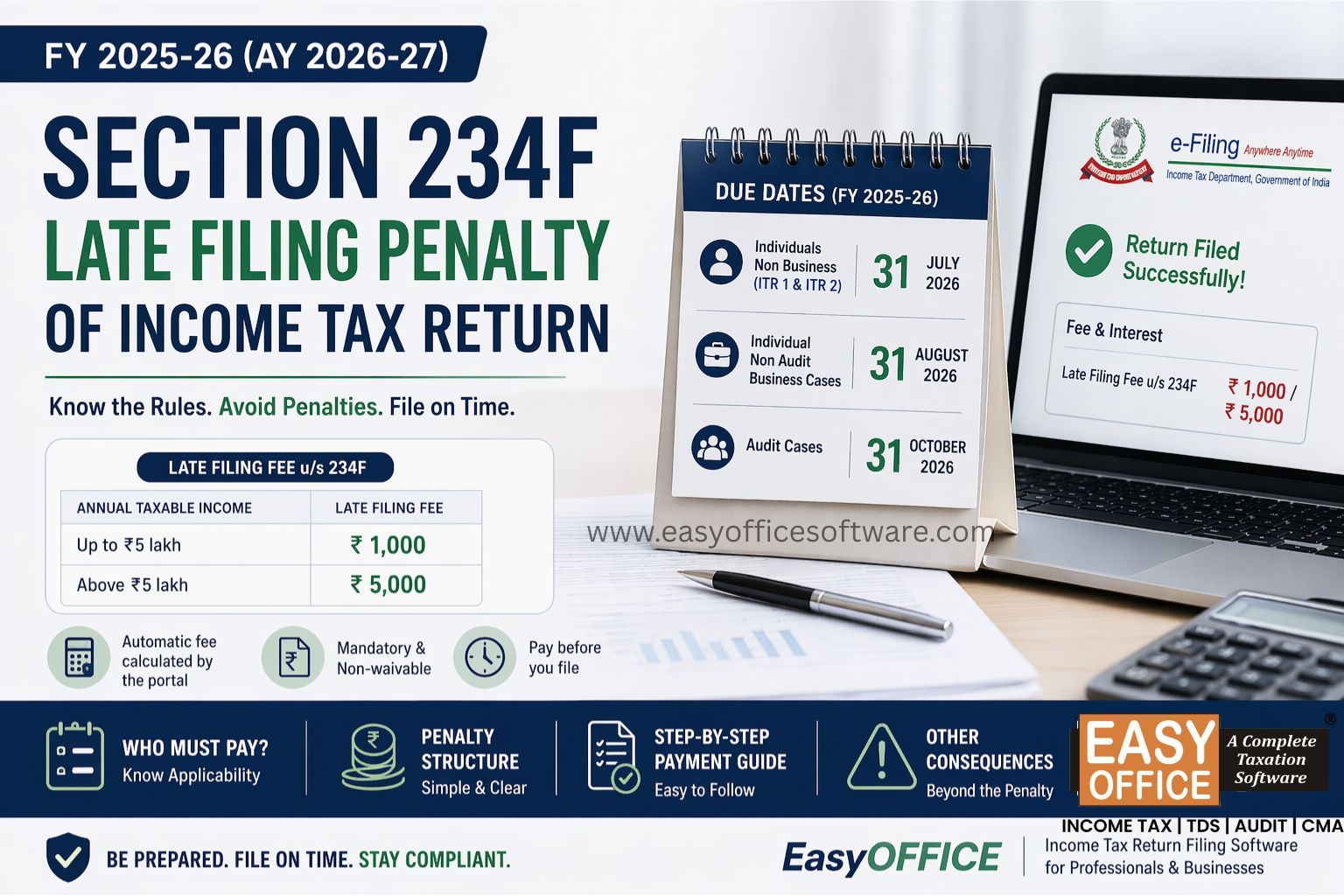
i. 31st July for individuals and non-audit cases
ii. 31st October for audit cases
iii. 30th November for transfer pricing cases
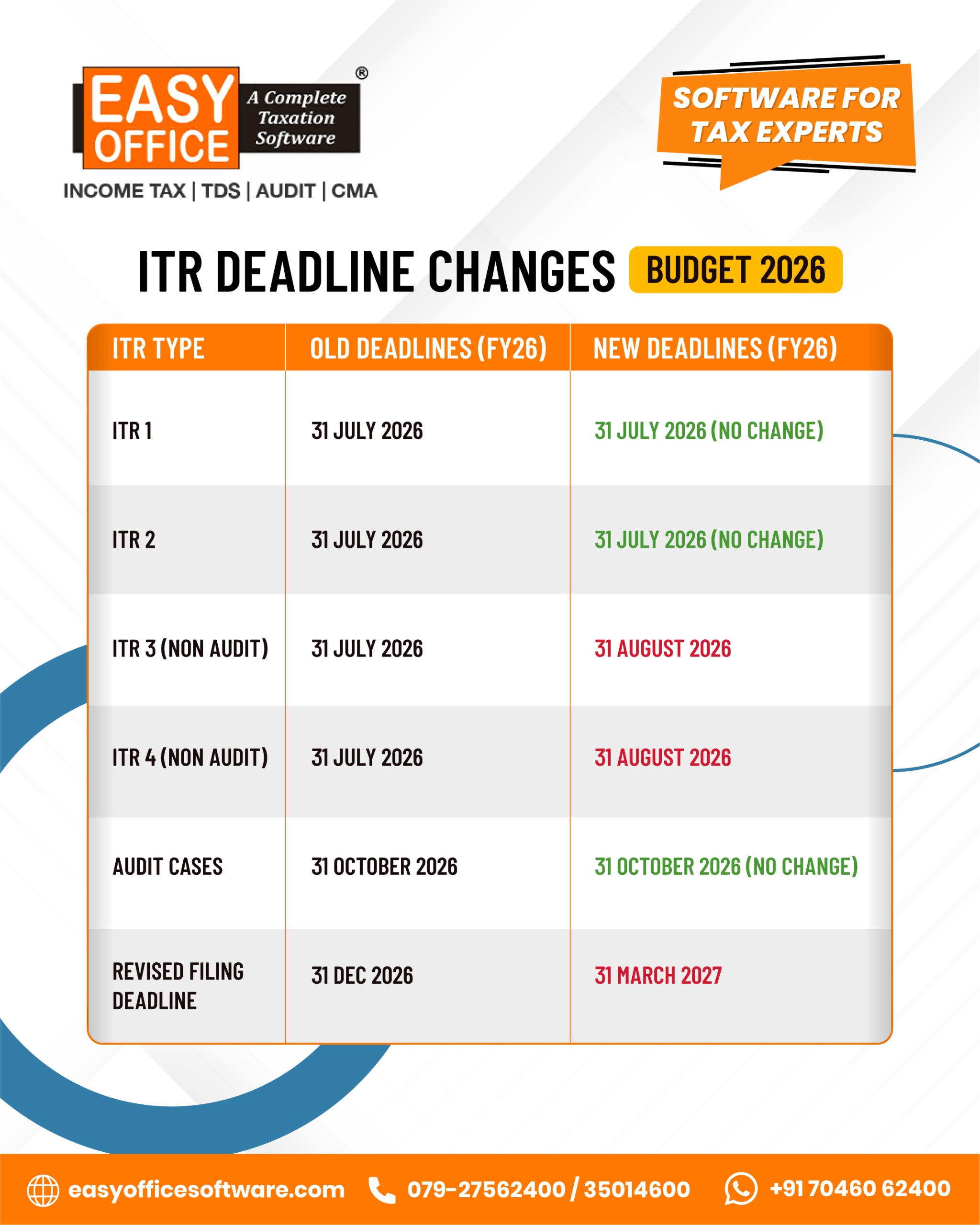
Budget 2026 Amendment:
ITR Deadline revised to 31st August for individuals and non-audit business cases. Individuals and non-business cases with ITR 1 and ITR 2 Deadline will be still 31st July.
When Does an ITR Become a Belated Return?
The moment the original due date passes, any return you file after that date is treated as a belated return under Section 139(4).
Even if your income is low or tax payable is nil, missing the deadline still changes the nature of your return.
Penalty for Filing Belated Return
The most common concern is penalty.
Under Section 234F:
(i) ₹5,000 late fee if income exceeds ₹5 lakh
(ii) ₹1,000 late fee if income is up to ₹5 lakh
(iii) No penalty if total income is below the basic exemption limit
Interest Payable on Late Filing
Apart from penalty, interest may be payable under Section 234A.
Interest is calculated at:
(i) 1% per month or part of the month
(ii) On the outstanding tax amount
(iii) From the due date till the actual filing date
This is why filing early - even after missing the deadline - reduces cost.
Can Losses Be Carried Forward in a Belated Return?
This is a critical point many taxpayers miss.
Losses that cannot be carried forward if the return is belated:
1. Business loss (except unabsorbed Depreciation)
2. Capital loss
Losses that can be carried forward even if the return is belated:
1. House property loss
2. Unabsorbed Depreciation
For freelancers, traders, and investors, late filing can mean losing valuable tax benefits.
Can You Revise a Belated Return?
Yes. As per current law, belated returns can be revised within the allowed time limit.
This is helpful if:
i. You missed reporting some income
ii. You selected the wrong ITR form
iii. You need to correct deductions
However, multiple revisions can increase scrutiny, so accuracy is key.
How to File Income Tax Return After Due Date
Filing a belated return online is simple if done correctly.
The general steps include:
1. Logging into the income tax e-filing portal
2. Selecting the correct ITR form
3. Choosing filing type as “Belated Return”
4. Paying tax, interest, and penalty
5. Verifying the return using Aadhaar OTP or EVC
Using income tax return filing software - EASYOFFICE automates these steps and reduces errors.
Common Mistakes to Avoid While Filing Belated Return
Some frequent mistakes include:
I. Ignoring interest and penalty calculation
II. Filing under the wrong ITR form
III. Not matching income with AIS
IV. Mismatch in Tax Credits
V. Forgetting to verify the return
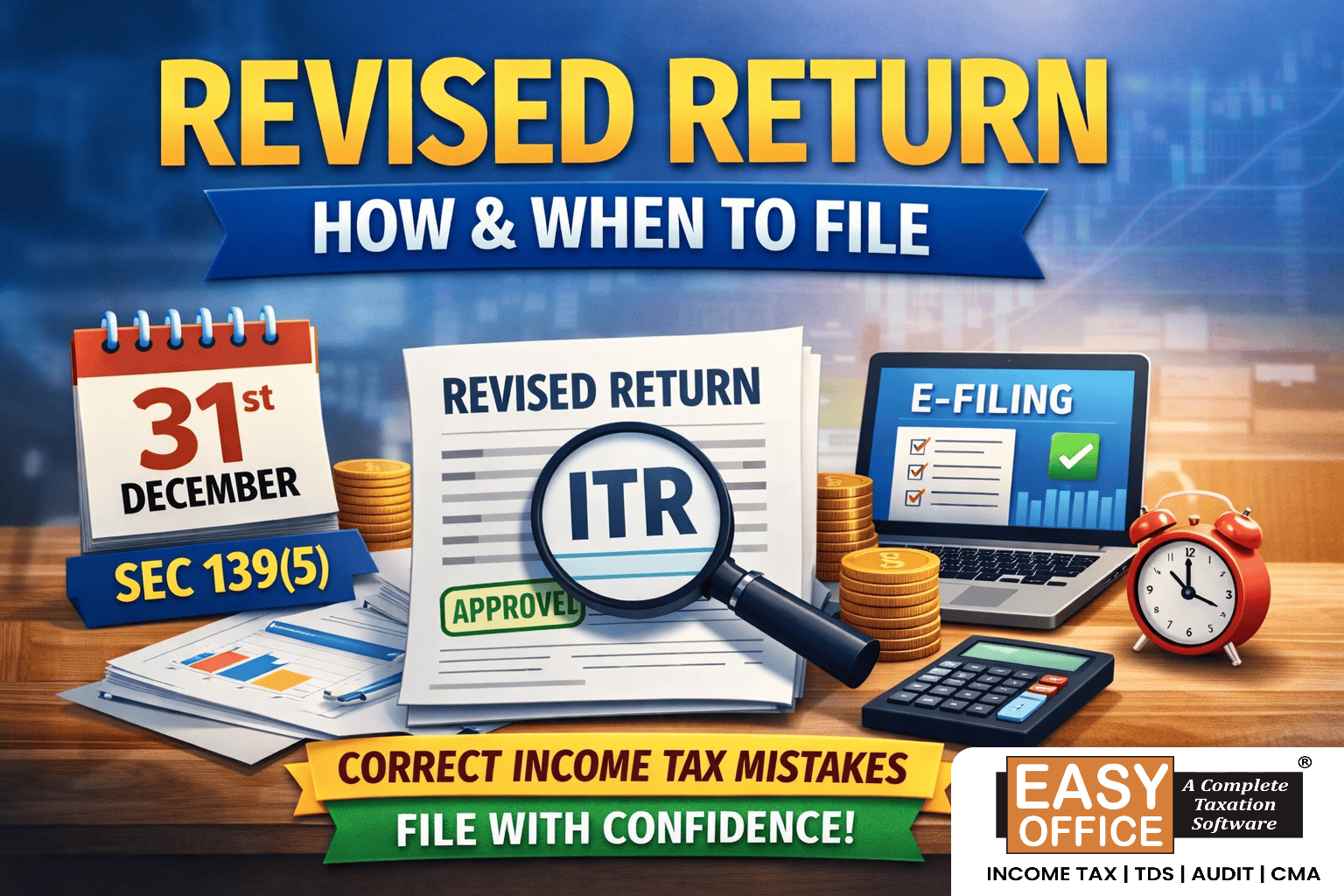
Belated Return vs Revised Return
A belated return is an original return filed after the due date.
A revised return is filed to correct errors in an already filed return.
Both serve different purposes but are often confused.
Why Filing Late Is Better Than Not Filing
Not filing at all can result in:
>> Heavy penalties
>> Best judgment assessment
>> Legal action in extreme cases
Filing a belated return keeps you on the right side of the law.
How Technology Helps in Belated ITR Filing
Manual calculation of interest and penalty is error-prone. Modern income tax return filing software offers:
>> Auto-calculation of penalty and interest
>> AIS and 26AS reconciliation
>> Error checks before submission
>> Faster and safer filing
Solutions from EasyOFFICE – Income Tax Software are designed to simplify compliance for individuals, professionals, and businesses—even in belated filing cases.
Frequently Asked Questions (FAQs)
1. What is the last date to file a belated return?
Generally, 31st December of the assessment year, unless extended. For AY 2025-26, Last date is 31st December 2025.
2. Is penalty mandatory for belated return?
Yes, except for income below the exemption limit.
3. Can I get a refund if I file a belated return?
Yes, but refunds may be delayed.
4. Can belated return be revised?
Yes, within the allowed time limit. Revised Return Due date has been Revised by Budget 2026 and now Assessee can file revised return till 31st March of Assessment year (Applicable from 1st April 2026)
5. Is income tax return filing software useful for late filing?
Absolutely. It reduces errors and saves time.
Final Takeaway
Missing the ITR due date is not the end of the road. Filing a belated return under Section 139(4) helps you stay compliant and avoid bigger problems later.
With increasing scrutiny and automation, using reliable income tax return filing software is the smartest way to file accurately—even after the due date.
With the right technology partner like Electrocom Software Pvt Ltd, late filing becomes simple, secure, and stress-free.
Belated return, Section 139(4), late filing income tax return, income tax return filing software, ITR after due date, Section 234F penalty, income tax compliance India




All in one Software
- Income Tax Software
- TDS & TCS Software
- Audit e-filing Software
- CMA Data Software















Penalty for Late Filing of Income Tax Return for FY 2025-26 – Section 234F of Income Tax Act 1961
#ITR